
The Abu Dhabi aerospace MRO market is being shaped by two intersecting trajectories: a global rise in maintenance demand and local investment aimed at capturing more engine and component work. Exactitude Consultancy estimates the global Aircraft Maintenance, Repair, and Overhaul (MRO) market at approximately $90 billion as of 2024. The same source projects the market will reach $155 billion by 2034, with a 6.2% CAGR from 2025 to 2034. These global figures do not describe Abu Dhabi alone, but they set the demand backdrop that incentivizes capacity additions and ecosystem buildout across the region.
At the regional level, Aviation Week’s 2026 Fleet & MRO Forecast placed the Middle East as the second fastest-growing MRO region globally. It projects demand increasing from $7.8bn in 2022 to $12.9bn by 2031. Aviation Week also quoted Lufthansa Technik Middle East’s CEO describing a “complete aerospace ecosystem” emerging in the region, with the sentiment shifting from whether it makes sense to be in the Middle East to “Why are you not here.” This framing matters for Abu Dhabi because it positions local capacity as part of a broader cluster competing for global airline and lessor work.
Mubadala-Backed Sanad: Engine Inductions, Revenue, and New Capacity
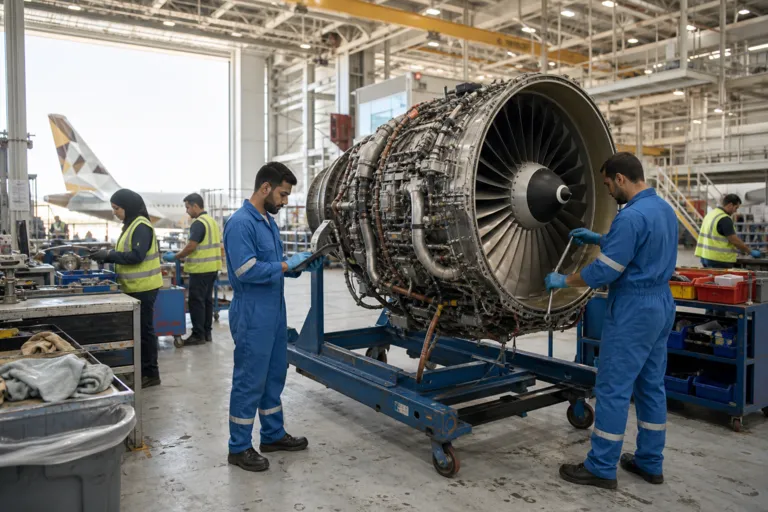
Mubadala’s role in Abu Dhabi’s MRO story is visible through Sanad’s recent performance and forward build plans. Aviation Week reported that Sanad achieved record revenue in 2025, as global engine shop capacity constraints drove a sharp rise in shop inductions. Sanad inducted approximately 230 engines into its MRO shops in 2025, up from 161 inductions in 2024. Revenues climbed 41% year-over-year to AED 7 billion ($1.9 billion). Aviation Week also reported that in 2025 the company invested more than AED 100 million to expand shop floor capacity and repair capabilities, aligning spending with demand signals in the engine aftermarket.
Capacity expansion is also being anchored by a long-term OEM-linked program. Aviation Week reported that the group is building a Pratt & Whitney GTF MRO shop following the signing of a 30-year agreement in February 2025. The facility is planned for the Al Ain region, around 100 miles east of Sanad’s Abu Dhabi headquarters. Once operational in Q3 2028, the shop is expected to handle 350 engines annually. It will also operate two large test cells, with capacity for 500 tests annually, and Aviation Week separately noted twin test cells capable of conducting more than 500 engine tests annually when completed in 2028.
Strata is often discussed alongside Mubadala when stakeholders describe Abu Dhabi’s aerospace footprint, but the provided sources do not include Strata-specific statistics or quantified MRO outputs. What can be stated, using only the sources, is that the global and regional demand context is expanding and that Abu Dhabi-based, Mubadala-owned capabilities are scaling into that demand. Exactitude’s projection to $155 billion by 2034 and Aviation Week’s Middle East forecast growth to $12.9bn by 2031 help explain why long-duration agreements, new engine lines, and more test capacity are being pursued. The result is a clearer demand trajectory for the Abu Dhabi aerospace MRO market, with engine work at the center of near-term growth.
What is the Abu Dhabi aerospace MRO market being driven by in the sources?
How big is the global Aircraft MRO market, and what is the projection?
What does Aviation Week forecast for Middle East MRO demand?
What did Sanad report for 2025 inductions and revenue?
What are the planned capacities for Sanad’s GTF facility in Al Ain?