
Abu Dhabi EV charging infrastructure discussions in 2026 are happening in a market where demand signals and grid planning are moving quickly. UAE-wide indicators show momentum. Industry data cited in a UAE rental-fleet announcement says EV and hybrid vehicles are about 5% of total UAE rental fleet inventory, with expectations to grow as consumer awareness and charging infrastructure expand. The same source notes the UAE hosted about 2,000 public EV charging points as of 2023. For investors, these figures matter because rentals expose more drivers to EVs, which can convert into repeat usage and higher charging utilization over time.
Market value projections add a second demand lens. One source cites Mordor Intelligence estimates that the UAE hybrid and electric vehicles sector was USD 3.01 billion in 2025 and is forecast to reach USD 7.68 billion by 2029, at a 26.37% CAGR. While this is not a charging-only forecast, it is a direct signal that the addressable EV ecosystem is expected to expand in the second half of the decade. In parallel, the global New Energy Vehicle charging infrastructure market was valued at USD 16 billion in 2024 and is projected to reach USD 40 billion by 2034, growing at a 10.3% CAGR, according to Exactitude Consultancy.
2026 Investment Outlook: Where the Infrastructure Case Gets Practical
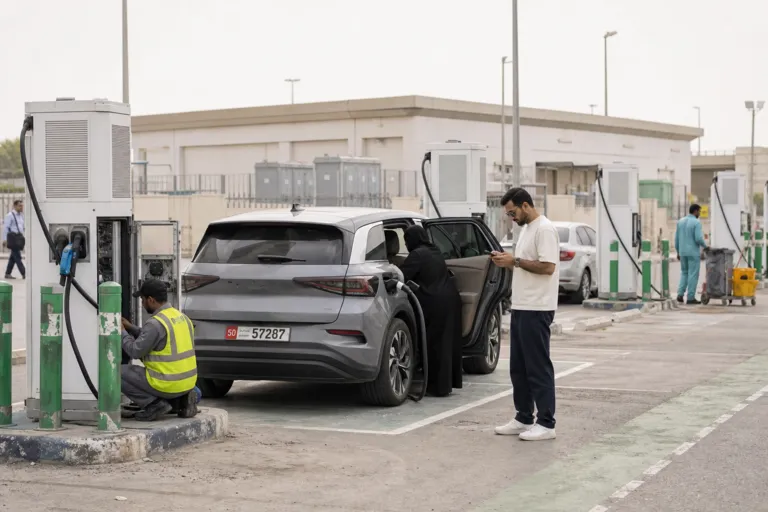
Investors typically underwrite charging networks against access, reliability, and expansion visibility. On access, Dubai’s DEWA EV Green Charger network is targeting 1,000 charging stations by end of 2025, and the UAE had about 2,000 public EV charging points as of 2023. Even though that DEWA target is Dubai-specific, it signals a national direction: building enough public charging density to reduce range-related barriers, including for short-term rental users. For Abu Dhabi, the takeaway is not the Dubai count itself, but the proof that large-scale, time-bound charging rollouts are already being executed in the country.
On reliability, grid context shapes charging economics. pv magazine reports GlobalData expectations that UAE gas-fired capacity expands from 44.4 GW in 2025 to nearly 46 GW by 2035, while nuclear capacity is forecast to remain stable at about 5.3 GW. The same reporting cites indicative market estimates that the UAE’s cumulative battery storage capacity was around 518 MW in 2025 and is expected to rise to about 1.1 GW by 2030. For Abu Dhabi EV charging infrastructure investors, these figures help frame how the broader power system may support more electrified transport loads, especially as solar and storage additions scale.
Local demand competition for electricity is also part of the 2026 outlook. A Forbes contributor article states Microsoft committed $15.2 billion to UAE data centers in 2025 and describes engineering contracts specifying natural gas turbines delivering 99.999% uptime, which it translates as 5.26 minutes of acceptable downtime annually. While the article focuses on data centers, the reliability benchmark highlights why charging projects often need strong utility coordination and resilient interconnection plans. In Abu Dhabi, the investment case can strengthen when site selection and grid capacity planning align with these reliability expectations.
Finally, product availability can accelerate charging usage. A UAE rental platform announcement describes adding EV and hybrid models such as Tesla Model 3, Tesla Model S, BYD Atto 3, and Rolls-Royce Spectre to its fleet, noting the company’s broader inventory spans more than 50 global automotive brands. As more vehicle segments appear in rental and chauffeur contexts, charging becomes less niche and more routine. That trend can lift utilization for public and destination chargers alike. In 2026, Abu Dhabi EV charging infrastructure investors can watch rental fleet electrification, national charging-point expansion signals, and grid stability additions as the most concrete demand-and-supply markers available in the cited sources.
What does the keyword “Abu Dhabi EV charging infrastructure” imply for 2026 planning?
How large is the UAE hybrid and electric vehicles market in the sources?
What charging expansion signals are cited in the UAE?
What grid or reliability indicators matter for charging investment decisions?