


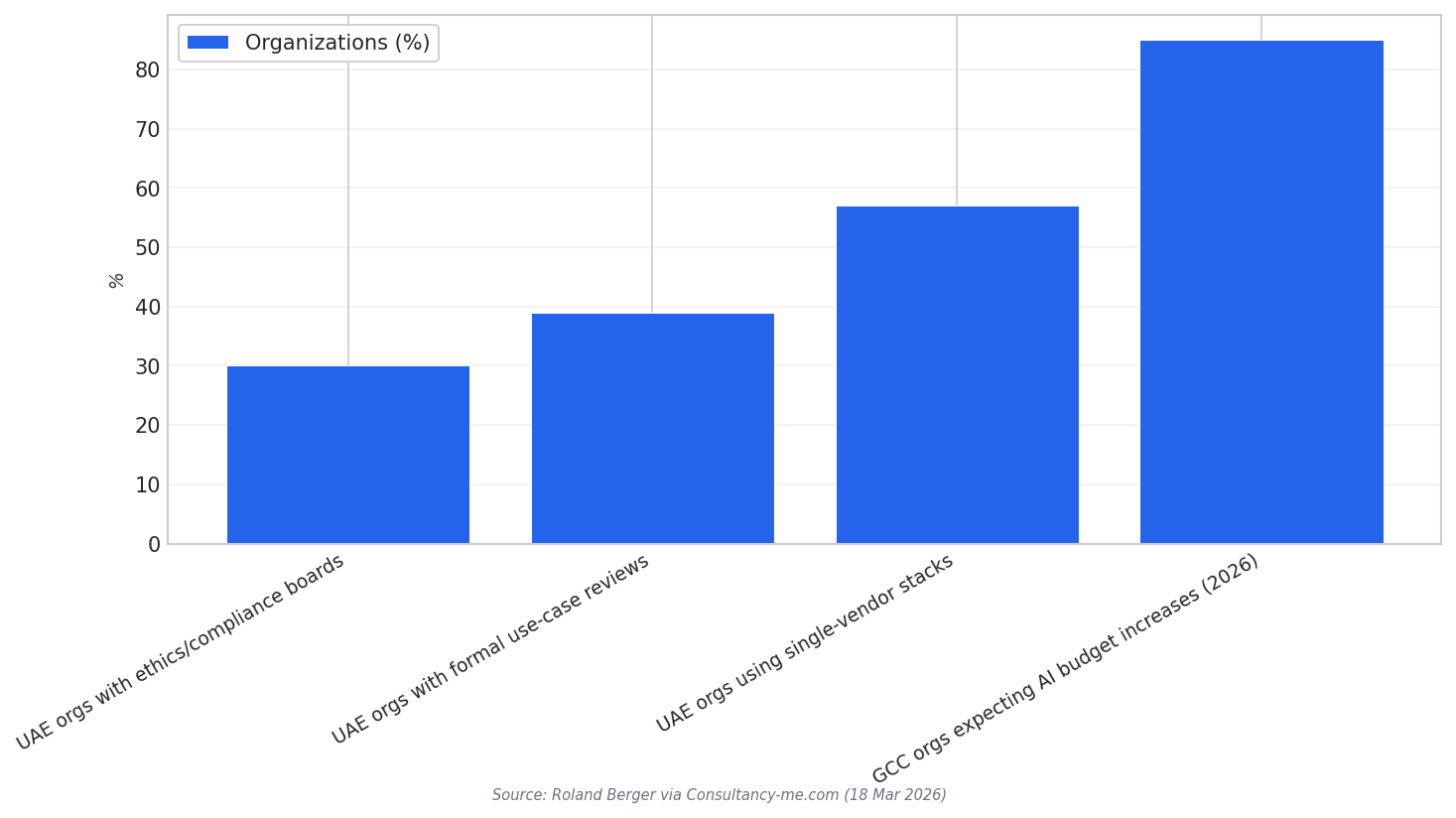
In 2026, many UAE organizations are moving from experimentation to AI as a long-term strategic priority, while still facing challenges in scaling solutions. A Roland Berger report says the UAE is leading among the GCC countries in governance maturity. It notes that around 30% of organizations have established dedicated ethics and compliance boards, and 39% use formal review processes for new AI use cases. For businesses planning for AI regulation UAE expectations, this matters because it signals a shift toward structured approvals, documented decision-making, and ongoing oversight rather than ad hoc deployments.
Budget and operating structure also shape compliance readiness. Across the GCC, 85% of organizations expect AI budgets to increase in 2026, with the UAE among the most active markets driving the momentum. Roland Berger also finds that more than two-thirds of entities have implemented centralized or hybrid operating models to manage AI initiatives. In parallel, 57% of local organizations have opted for single-vendor technology stacks to support smoother integration with government-backed ecosystems. These choices can simplify controls, but they also make it vital to define ownership, escalation paths, and governance checkpoints across the full AI lifecycle.
A 2026 Compliance Map: Governance, Data, Audit, and Oversight
Start with a governance framework that helps legal, compliance, and business leaders move at the right speed. Bloomberg Law highlights that legal teams should guide AI adoption so the organization does not move too slowly and fall behind, or too quickly and take on regulatory, reputational, or operational risks. It also warns that improper implementation of AI-powered biometric tools, such as facial recognition for employee verification, can expose employers to costly fines or litigation costs for misuse of personal information. This turns “policy” into operational work: clear usage rules, controlled access to sensitive data, and review before rollout.
Data governance is a core compliance dependency, especially in regulated sectors. Consultancy-me notes that in progressive UAE financial institutions, internal audit functions are becoming active stakeholders in data regulatory automation projects. They challenge governance models before implementation, assess data lineage, and influence design from the outset. The same source frames the recurring lesson across major regulatory transformations as “data,” not models. This supports a practical compliance map: define data ownership, ensure traceability, and involve audit early so AI controls are built in, not bolted on after deployment.
Finally, plan for continuous assurance and human oversight as automation expands. SecurityWeek describes AI-driven compliance tools where LLMs ingest new regulations and map requirements to internal controls, identifying gaps in real time. It also describes agentic systems that continuously monitor infrastructure and data flows and generate instant, auditable reports. At the same time, SecurityWeek notes AI is probabilistic and changes quickly, which complicates regulation and adherence. In government, the UAE has announced a plan to deliver 50% of all government services via autonomous AI agents within two years, while industry leaders still stress human oversight for compliance and accuracy. Businesses operating in 2026 should mirror that balance: automate checks, but keep accountable humans in the loop.
What does “AI regulation UAE” compliance look like for businesses in 2026?
Which governance structures are UAE organizations already using for AI?
Why is data governance central to AI compliance in the UAE financial sector?
How can AI help manage compliance complexity in 2026?
Does automation remove the need for human oversight?