
Vertical farming is increasingly positioned as part of Abu Dhabi’s wider push for food resilience in arid conditions. The UAE’s National Food Security Strategy 2051 aims to strengthen domestic food production while reducing vulnerability to global supply disruptions. It emphasizes modern farming technologies, research and development, supply chain resilience, and public-private partnerships. Recent global disruptions reinforced why this matters. Pandemic-related shipping delays, geopolitical instability, rising transportation costs, and climate-driven agricultural shocks exposed the fragility of heavily import-dependent food systems. In this context, controlled-environment agriculture is framed as production capability, not just an innovation story.
For commercial buyers, the value proposition links directly to logistics. One UAE report notes that produce can move from harvest to shelves within 24 to 48 hours. That predictability has commercial value for retailers and hospitality operators, because it can reduce storage time and waste while improving freshness. The same report ties the food strategy to logistics, supply chain efficiency, and digital infrastructure. In practice, the Abu Dhabi vertical farming market conversation is not only about growing indoors. It is also about building a dependable pipeline from controlled environments to end customers on a tight clock.
Key Operators and What They Signal About Demand
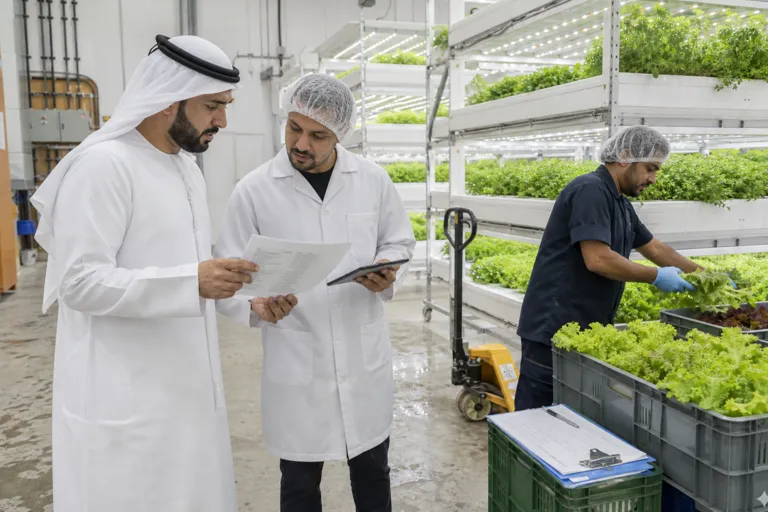
In UAE coverage of vertical and hydroponic farming, companies such as UNS and Pure Harvest are presented as active shapers of the sector, not passive participants. The same coverage describes how automation and IoT-style monitoring support consistency, with systems tracking light levels, humidity, nutrient balance, and CO2 levels and adjusting in real time. It also states that this approach can produce 10–15 times more food per square metre than conventional farms. That claim is paired with a strong market message: buyers, partners, and investors want numbers and repeatability, not vague claims.
At the Global Vertical Farming Show in Dubai, the recurring theme was commercial discipline linked to food security. Government representation included His Excellency Dr. Mohammed Al Hammadi, Assistant Undersecretary for the Food Diversity Sector at the UAE Ministry of Climate Change and Environment, in a session that highlighted commitment to diversifying the food supply. Industry voices also made the unit-economics problem explicit. Tom Stenzel of the CEA Alliance said companies need to understand two major things: their cost structure and who is going to buy the product. The event’s takeaway stressed profitability, consistent operations, and partnerships that deliver real food security.
Unit economics in vertical farming are also framed by constraints, not only yield potential. A market commentary notes that the strongest operating constraint inside vertical farming remains energy exposure, and it argues that commercial resilience depends on balancing water productivity, energy efficiency, automation intensity, crop economics, distribution proximity, and environmental consistency. Separately, an urban agriculture overview acknowledges vertical farming’s promise in land-scarce environments, especially when combined with hydroponics to conserve water, but also points to limitations including high energy costs, reduced crop diversity, and labor trade-offs. For Abu Dhabi, the business case therefore depends on aligning buyer demand, energy discipline, and operations that stay consistent over time.
What is driving the Abu Dhabi vertical farming market?
What unit-economics questions do vertical farming operators need to answer?
Why do retailers and hospitality buyers value indoor-grown produce in the UAE?
What productivity claim is reported for tech-enabled controlled-environment systems?