


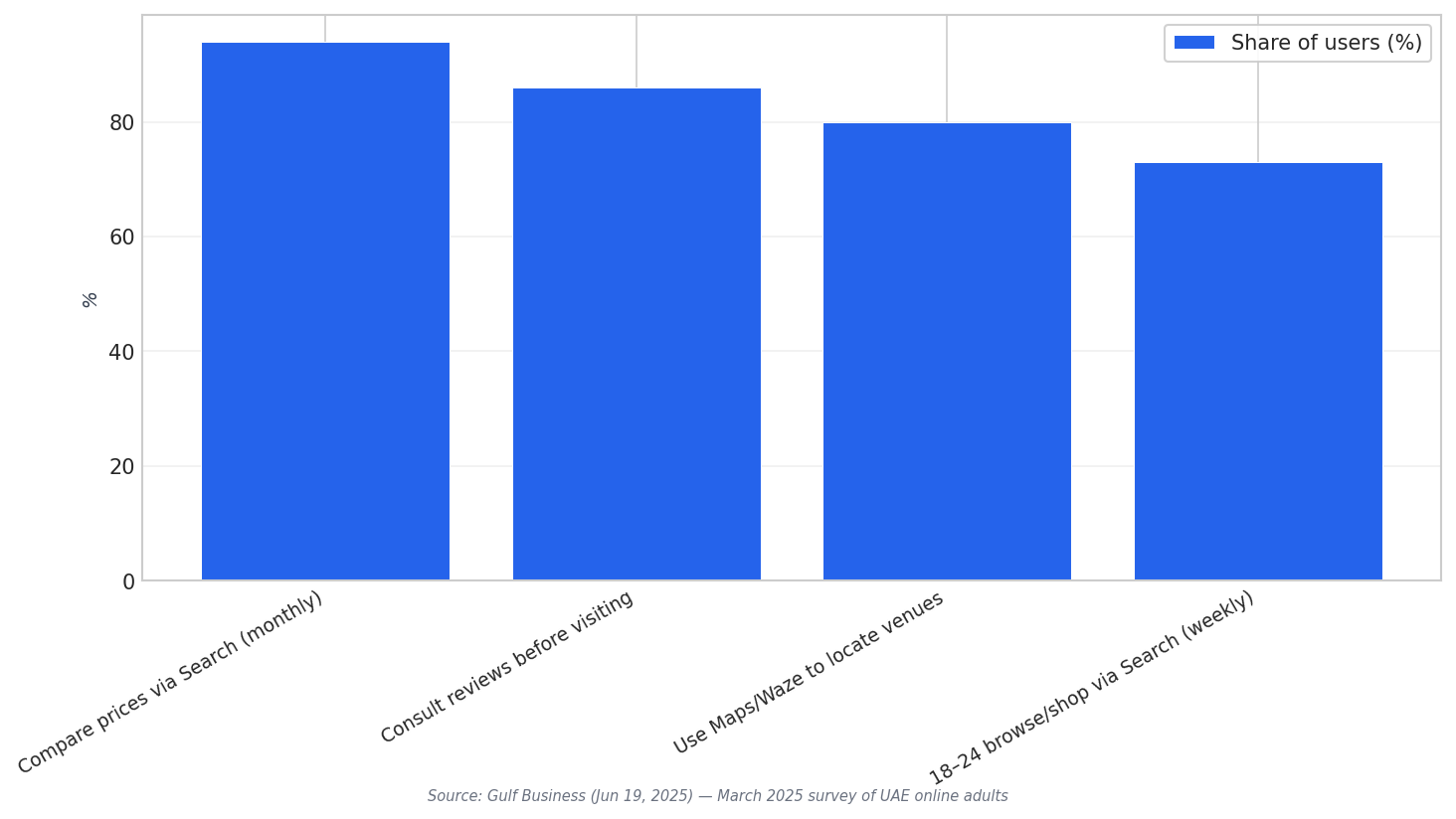
Conjoint analysis is a practical way to make pricing and feature decisions with less guesswork. It focuses on trade-offs. Instead of asking customers whether they “like” a feature, it measures what they choose when price and features change together. That matters in the UAE because shoppers actively research before they buy. A March 2025 survey of 1,110 UAE-based online adults found that 94% use Google Search monthly to compare prices. The same study reported 86% consult Google reviews before visiting businesses. These behaviors create a strong foundation for structured choice testing.
Those digital signals can guide how you design conjoint studies and the attributes you test. If 94% are comparing prices, price must be a core attribute in your experiment. If 86% check reviews before visiting, reputation signals can be tested as part of the offer, such as service assurances or proof points that reduce risk. Navigation behavior also matters for local and omnichannel choices. The same UAE survey reports 80% use Google Maps or Waze to locate local venues. For younger audiences, 73% of 18–24-year-olds browse or shop online via Search weekly, which supports testing online-first bundles and fast checkout features.
Applying Conjoint Analysis UAE to B2C and B2B Decisions
In B2C, conjoint analysis UAE can be used to design subscription bundles and quantify what “value” should look like in price tiers. Careem’s 2025 trends report shows value-led loyalty in action: Careem Plus members saved an average of AED 375 per month in 2025, a 25% increase compared to 2024. The same report notes one member saved over AED 18,200 during the year. These figures do not explain which benefits drove those savings, but they show why testing benefit mix versus price matters. Conjoint can help separate which benefits should be included by default and which should be paid add-ons.
In B2B, conjoint analysis is useful when buyers want speed, clarity, and self-service. Manufacturing commentary notes that a new generation of B2B buyers expects to research, configure, and purchase at their own pace, and they will switch if that is not available. That environment makes it easier to define measurable attributes for conjoint, such as quote turnaround, configuration options, and purchasing workflow. Pricing decision-making is also becoming more systematic. One manufacturing pricing article describes AI pricing agents that monitor market signals, run what-if simulations, and propose changes with explanations and guardrails, enabling approvals and later audits. Conjoint outputs can feed those “what-if” simulations by grounding them in buyer trade-offs.
To run conjoint analysis UAE well, keep the study grounded in the market’s real decision context. Use realistic price ranges, and include the features customers actually compare. The March 2025 UAE surveys were conducted in English and Arabic and weighted to ensure national representation, which is a reminder to match language and sampling to your audience. Finally, interpret results as a decision tool, not a single “right price.” Use them to choose a feature roadmap, design bundles, and set pricing guardrails that can be reviewed as customer signals and feedback evolve.
What is conjoint analysis UAE used for?
Which UAE digital behaviors make conjoint studies more relevant?
How can conjoint analysis support subscription pricing decisions in the UAE?
How does conjoint help with B2B pricing and quoting?