
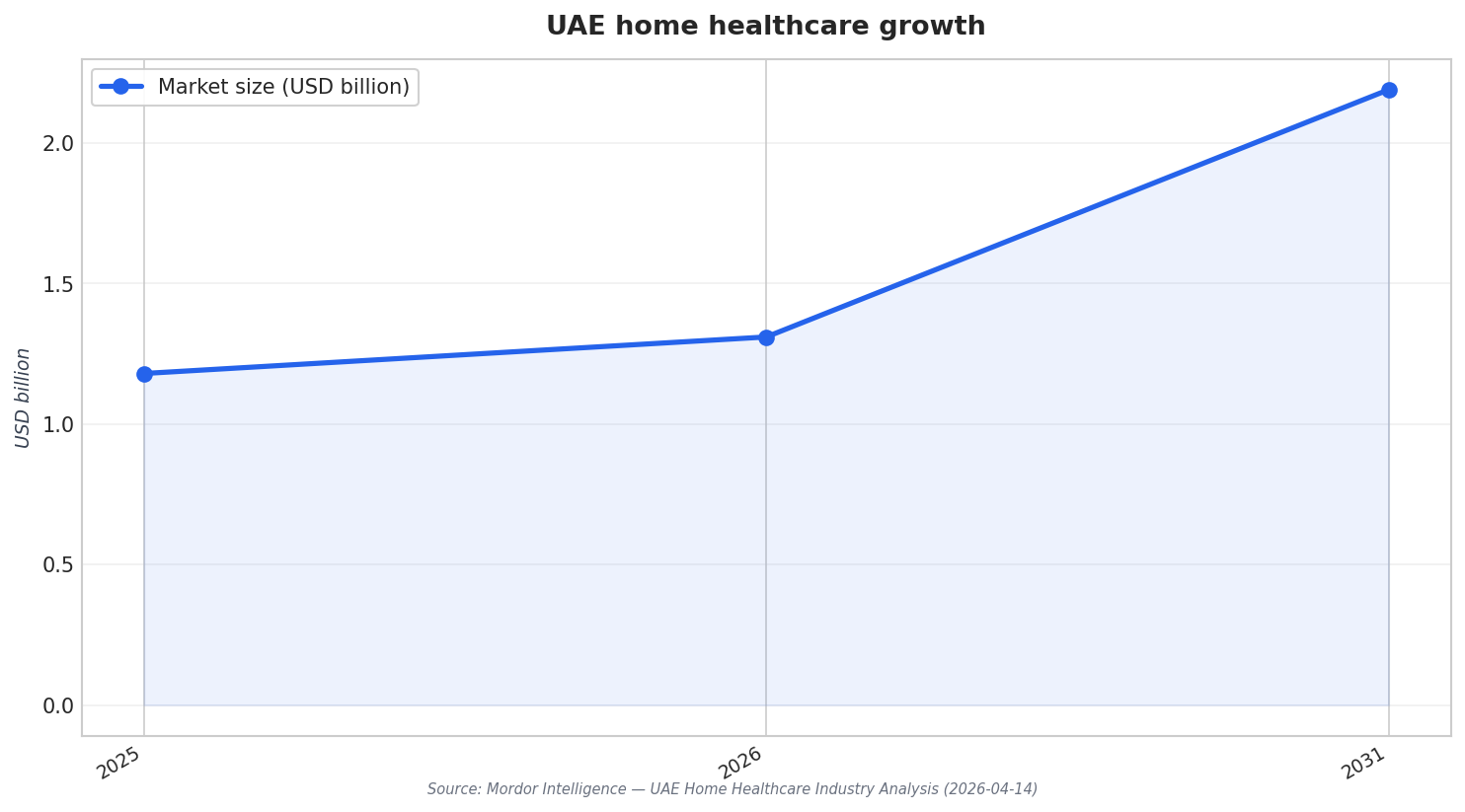
Planning for 2026 in Abu Dhabi increasingly means linking rehabilitation pathways with elderly care delivery, especially in the home. Across the UAE home healthcare industry, market size is projected to expand from USD 1.18 billion in 2025 to USD 1.31 billion in 2026, with a further projection to USD 2.19 billion by 2031 at a CAGR of 10.84% from 2026 to 2031. This expansion matters to the Abu Dhabi elderly care market because it signals a broader build-out of clinician deployment, software platforms, and therapy services that can support older adults and people with chronic conditions. Abu Dhabi and Dubai initiatives that promote virtual nursing, predictive analytics, and unified licensing are also framed as enablers for scaling care more efficiently across emirates.
A key demand driver is the nationwide mandatory health insurance rollout that came into force on 1 January 2025. The compulsory basic coverage is priced at AED 320 (USD 87.0) per beneficiary and extends to roughly 3 million workers who previously lacked formal access to healthcare services. The scheme standardizes home-care benefits across all seven emirates. It also sets co-payments at 20% for inpatient and 25% for outpatient episodes, with no waiting periods for pre-existing conditions. For providers, this combination supports higher volumes of reimbursed home nursing visits, as early claims data indicate a surge in utilization, reflecting demand that had been suppressed by cost barriers.
Rehabilitation Services: The Center of Home-Based Capacity Growth
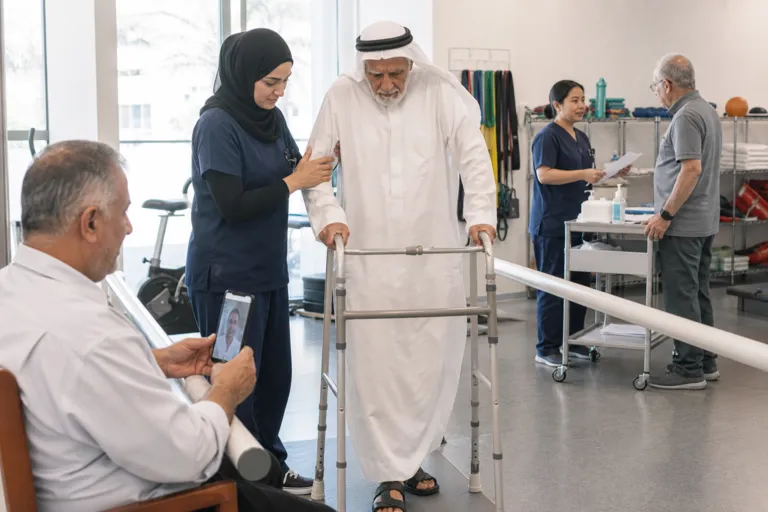
Rehabilitation is already a large component of UAE home healthcare capacity. Rehabilitation therapy services accounted for 37.74% of the UAE home healthcare market share in 2025, making it a core service line to scale for 2026. Regional context also points to faster growth in home-based rehabilitation: in the Middle East and Africa home healthcare market, the rehabilitation therapy services segment is described as the fastest-growing and is projected to grow at a CAGR of 21.4% between 2025 and 2033, driven by rising demand for post-stroke, post-orthopedic, and neurorehabilitation care delivered at home, along with the expansion of insurance coverage for home rehabilitation. On the product side within the UAE home healthcare market, therapeutic products led with a 46.28% revenue share in 2025, while mobility care products are expected to expand at an 11.21% CAGR through 2031, aligning with increased demand for postoperative rehabilitation support.
Technology-enabled delivery is another lever for both capacity expansion and patient experience in 2026. Clinical management systems captured 51.92% of the UAE home healthcare market in 2025, and agency software platforms are poised to grow at a 10.96% CAGR through 2031, reinforcing the shift toward structured scheduling, documentation, and remote coordination. AI-driven telehealth platforms are increasingly shaping patient expectations, and the UAE rehabilitation products landscape highlights tele-rehabilitation as a specific opportunity, with the market expected to grow by AED 250 million in future. At the same time, execution risk is tied to staffing. The UAE is described as having a workforce of 29,860 physicians and 63,366 nurses for 11.35 million residents, yet still experiencing gaps in meeting rising in-home care needs, prompting tele-supervision and international recruitment efforts, especially for ICU and geriatric specialty areas.
Long-term demand drivers also extend beyond pure clinical rehabilitation into broader home care and long-term care categories that are relevant to Abu Dhabi service planning. The UAE long-term care market is expected to grow at a CAGR of 7% from 2026 to 2033, a directional signal that sustained need for ongoing support is being built into forecasts. Separately, UAE home care research notes consumer demand for in-home services such as elderly care, along with a significant increase in digital healthcare services, and identifies Dubai, Abu Dhabi, and Sharjah as key drivers of the market. It also states that, by 2024, the UAE population is expected to reach approximately 9.5 million and highlights that the Ministry of Community Development anticipates the elderly population’s share will increase in the coming years, driven by healthcare improvements and better living standards. For 2026, these factors reinforce why capacity expansion in home-based rehabilitation and coordinated long-term support remains central to Abu Dhabi’s care agenda.
What is shaping the Abu Dhabi elderly care market outlook for 2026?
How important is rehabilitation therapy within UAE home healthcare going into 2026?
What specific insurance details could increase demand for in-home elderly support?
Which technologies are highlighted as enabling scale in home-based care?
What is the long-term care growth signal relevant to 2026 planning in the UAE?