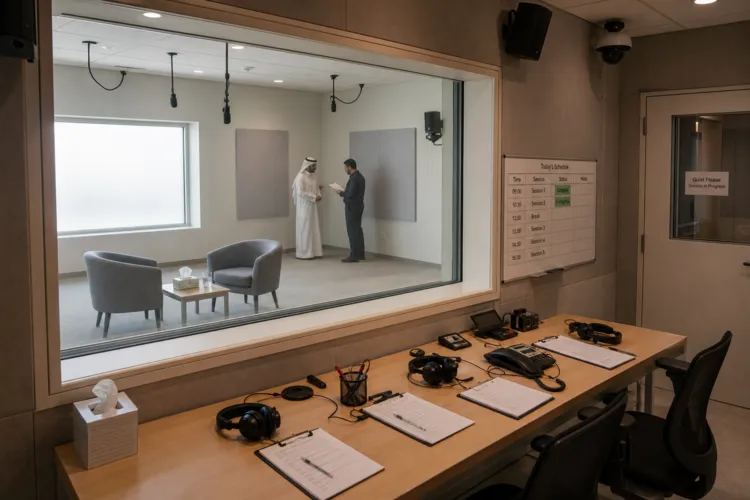


Arabic-English surveys in Abu Dhabi often look “bilingual” on the surface, yet still produce results that are hard to compare. The risk is not only translation quality. It is construct drift, different reading levels, and different response norms across languages. Evidence from UAE higher education shows that when parallel Arabic- and English-medium tracks are evaluated using the corresponding survey language, score differences can reflect course quality, but also survey language, linguistic proficiency, response norms, or other sociolinguistic features. In practice, bilingual questionnaire design UAE teams should plan for comparability, not just produce two language versions and hope the results align.
A core best practice is to build the questionnaire bilingually from the start. One methods guide recommends defining the construct you are measuring (such as intent, satisfaction, trust, or price sensitivity), agreeing on the reading level, and writing wording that works naturally in both languages. Translation then becomes a controlled process, not a last-minute step. Adjudication matters: a bilingual reviewer reconciles differences and documents choices, especially for key metrics and scale anchors. Back translation can also help detect subtle meaning drift, rather than only “catching mistakes.” In Abu Dhabi research, this discipline is essential when you need the Arabic and English results to mean the same thing for decision-making.
Abu Dhabi Fieldwork Realities: Sampling, Weighting, and Trust
Language design is only credible if the sample plan supports the comparisons you want to make. A UAE planning guide stresses there is no single interview count that suits every project. Start with the audience, decisions, and groups that must be compared, and define the target population precisely instead of claiming “UAE consumers.” The guide includes an illustrative allocation: 400 eligible users split into two groups yields a base of 200 per group, and splitting each group into four segments can leave an average base of 50 if evenly distributed. This is not a recommended size, but it shows how subgroup analysis can collapse if quotas and allocation are not planned before fieldwork.
Execution in the UAE also depends on bilingual collection and careful weighting. A UAE customer satisfaction methodology example was conducted in March 2025 with 1,110 UAE-based online adults and 389 business leaders, carried out in English and Arabic, and weighted to ensure national representation. The same source links satisfaction measurement to digital customer behavior: 94% use Google Search monthly to compare prices, 86% consult Google reviews before visiting businesses, and 80% use Google Maps or Waze to locate local venues (March 2025, UAE-based online adults). For Abu Dhabi studies, these behaviors can inform what you ask, but the bilingual questionnaire must keep constructs consistent across languages so that differences do not become “language effects.”
Finally, Abu Dhabi research often faces governance and context constraints that affect instrument choice. Public health researchers in the UAE can encounter layered ethics approval across facility, emirate, and federal bodies, and the need for validated Arabic or bilingual instruments. In Abu Dhabi, most human-subject research needs approval from a facility-level Research Ethics Committee or Institutional Review Board before analysis can begin. In workplaces, trust is another constraint: employee survey guidance emphasizes that platforms cannot compensate for a trust problem, and that multilingual, multicultural environments shape how questions are interpreted. Treat these realities as design requirements, not afterthoughts, and your bilingual questionnaire will be more comparable, ethical, and actionable.
What is the biggest risk in Arabic-English survey design for Abu Dhabi studies?
How should a team approach bilingual questionnaire design in the UAE from the start?
Why can a large total sample still fail subgroup comparisons in UAE surveys?
What UAE figures can inform customer satisfaction questionnaire topics?
What approvals commonly gate human-subject research in Abu Dhabi?