
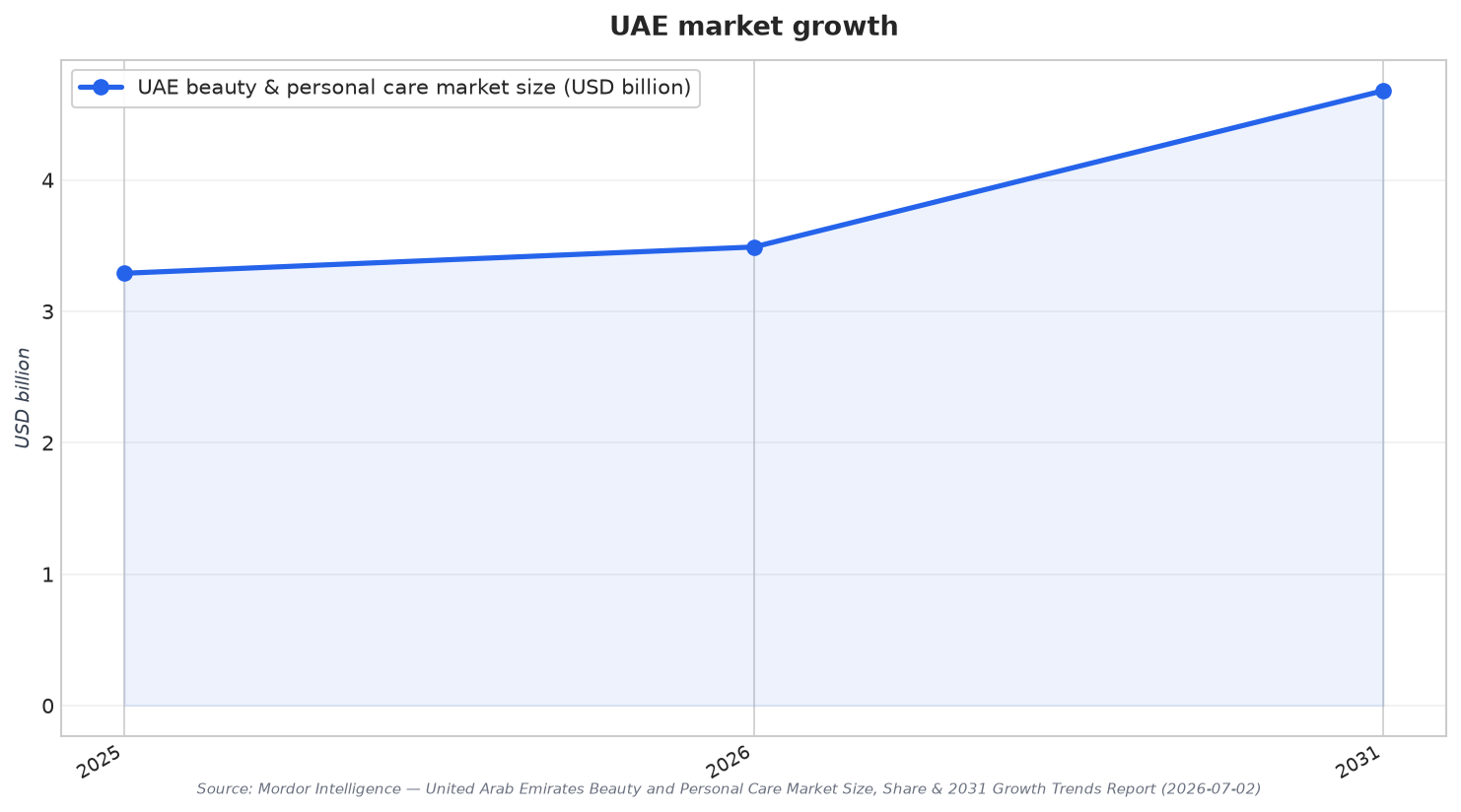
For 2026, the Abu Dhabi beauty personal care market is best read through the wider UAE numbers and the city’s role in high-income, high-choice consumption. Mordor Intelligence values the United Arab Emirates beauty and personal care products market at USD 3.49 billion in 2026, up from USD 3.29 billion in 2025, and forecasts USD 4.68 billion by 2031 at a 6.05% CAGR. The same report notes that Dubai and Abu Dhabi dominate consumption in the country, supported by large expatriate populations, higher disposable incomes, and extensive retail infrastructure, including duty-free operations that serve both residents and travelers.
Premiumisation is not replacing mass; it is layering on top of it. In the UAE color cosmetics segment, mass products held an 85.38% share in 2025, while premium products are projected to post the fastest growth, at a 6.25% CAGR through 2031. Product mix matters too. Facial cosmetics accounted for 67.21% of UAE color cosmetics in 2025, while eye cosmetics are forecast to expand at a 6.78% CAGR through 2031. This combination supports a market where consumers still buy across accessible price points but increasingly trade up in prestige channels when the proposition is clear.
Halal Cosmetics and Clean Labels: Compliance Becomes a Premium Lever
Halal alignment is moving from a checkbox to a differentiator, especially where it intersects with clean beauty cues. Mordor Intelligence’s Middle East and Africa coverage links regional growth to preferences for halal-certified and clean formulations, and highlights that halal certification requirements extend beyond ingredients into manufacturing processes. Within the UAE context, Dubai Municipality’s halal certification program is described as streamlining approvals for international brands seeking regional distribution. Globally, Straits Research estimates the halal cosmetics market at USD 53.24 billion in 2026, with projections to USD 131.81 billion by 2034 at a 12% CAGR, and it cites halal-certified launches in 2026 by INIKA Organic and Wardah.
Spending signals in Abu Dhabi are also shaped by channel shifts and travel-linked retail. In the UAE color cosmetics report, Dubai Duty Free recorded AED 8.68 billion in annual sales in 2025 (USD 2.38 billion), with cosmetics among the top-performing categories, underscoring how travel flows add demand beyond resident wallets. On the channel side, specialty stores held a 51.28% share of UAE color cosmetics in 2025, while online retail is forecast to grow at a 5.89% CAGR through 2031. MarkWide Research also describes online retail as the fastest-growing distribution vector as same-day delivery infrastructure matures across Abu Dhabi and Dubai.
Regulation and consumer trust will continue to influence what people buy and how brands position themselves. Mordor Intelligence notes that the UAE regulatory framework, governed by Dubai Municipality’s Montaji system and ESMA certification requirements, standardizes safety and quality across emirates. It also highlights enforcement activity: the Abu Dhabi Department of Health identified 41 unsafe products in early 2025, including cosmetics with unauthorized ingredients such as hydroquinone and clobetasol propionate. For 2026, this makes provenance, labeling discipline, and compliant formulation choices central to winning repeat purchases in Abu Dhabi’s competitive beauty landscape.
How fast is the UAE beauty and personal care market expected to grow from 2026 to 2031?
What does premiumisation look like in UAE color cosmetics?
Why are halal cosmetics becoming more important for brands selling into Abu Dhabi?
How do online channels factor into beauty spending trends in Abu Dhabi for 2026?
What key risks and safeguards shape the Abu Dhabi beauty personal care market?