
Abu Dhabi has approved the launch of the AgriFood Growth and Water Abundance (AGWA) cluster, an integrated economic cluster located in the emirate and positioned to support global efforts to tackle food shortages and water scarcity. The initiative is led by the Abu Dhabi Department of Economic Development (ADDED) and the Abu Dhabi Investment Office (ADIO). In official statements, the cluster is framed as a hub for novel food and ingredients and for technologies that increase access to, and the efficient utilisation of, water resources. It is designed to support local suppliers and exporters, and to serve as a platform to maximise commercial opportunities while building a reliable and resilient supply chain for food and water.
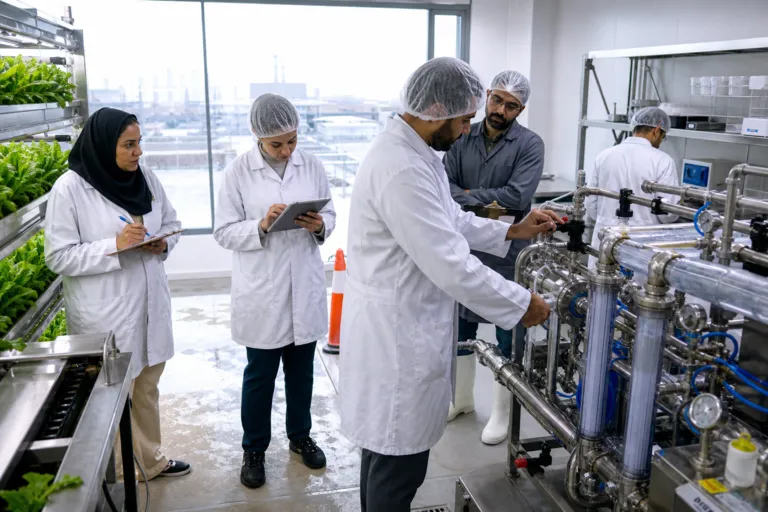
AGWA’s ambitions are spelled out in long-range targets and a specific technology focus. It is expected, by 2045, to contribute AED90 billion in incremental GDP to Abu Dhabi’s economy, create more than 60,000 new jobs, and attract AED128 billion in investments. The cluster also “taps into” an AED77.4 trillion industry, underscoring the scale of the global market context it aims to serve. The Abu Dhabi agrifood cluster narrative is not limited to food production alone; it explicitly connects food growth with water abundance, including support for innovations in alternative proteins, algae, and reverse osmosis technologies, alongside efforts to enhance traditional food and water production and supply.
Regulation, Licensing, and the “Build-to-Scale” Playbook
A central pillar of AGWA is the attempt to make regulation an accelerator rather than a constraint. ADIO, the Abu Dhabi Agriculture and Food Safety Authority (ADAFSA), and the Abu Dhabi Quality and Conformity Council (ADQCC) have agreed to work towards creating a regulatory environment intended to speed Abu Dhabi’s ambition to become a leading global food and water hub. The stated focus includes regulatory frameworks and support mechanisms that enable more efficient solutions across agriculture, food, and water. The plan also highlights efficient licensing and the need to ensure safe and secure production, with the explicit goal of attracting innovators and helping them launch new products and technologies inside the cluster.
AGWA also sits inside a broader cluster strategy that Abu Dhabi has been promoting across priority sectors. Commentary in The National points to advanced manufacturing and export-focused sectors as a way to anchor high-value production locally, citing clusters such as SAVI, HELM, and AGWA. The same piece notes that manufacturing remains a cornerstone of Abu Dhabi’s non-oil economy, generating a value added of Dh30.5 billion in the third quarter of 2025 and contributing 9.4 per cent to GDP. Separately, Gulf News reported that platforms including AGWA bring together regulation, talent, testing environments, and investor support, reflecting a consistent “ecosystem build” approach rather than isolated project announcements.
National-level context helps explain why the cluster model is gaining urgency. One outlook article cites IMARC Group estimates that the UAE agriculture market size was valued at USD3.6 billion in 2024 and could reach USD5.4 billion by 2033, with a 4.47% CAGR during 2025–2033. The same source describes the National Food Security Strategy 2051 as a 38-initiative plan and states that 85% of food is currently imported at a cost of roughly USD13.2 billion annually, with domestic consumption projected to rise 50% by 2030. Against that backdrop, AGWA’s 2045 targets, its novel food and water-tech priorities, and its regulatory partnerships read as a structured attempt to move from pilots to scalable production and exports.
What is AGWA, and where is it located?
What are AGWA’s targets for GDP, jobs, and investment by 2045?
Which technologies does AGWA highlight as priorities?
How is Abu Dhabi building the regulatory environment around AGWA?
How does the Abu Dhabi agrifood cluster approach fit into the emirate’s wider economic strategy?