
In the Abu Dhabi sustainable aviation fuel market, the near-term story is less about a single “silver bullet” and more about how quickly workable feedstocks and refining pathways can be industrialised. Across the Middle East, governments and airlines are moving SAF from pilot activity toward commercial strategy, as the global aviation industry faces growing pressure to reduce carbon emissions while maintaining long-term traffic growth. SAF is positioned as a near-term solution because it preserves existing aircraft infrastructure, and it can be blended at ratios up to 50% with conventional Jet A-1 under current ASTM D7566 certification standards. That “drop-in” advantage reshapes the investment case: the constraint is not aircraft readiness, but bankable supply chains.
Feedstock selection is where ambition meets practicality. SAF can be produced from non-fossil sources such as used cooking oil, municipal waste, agricultural residues, biomass, and synthetic fuels derived from green hydrogen. Market data also signals where supply pressure concentrates: one market report lists used cooking oil as the leading feedstock at 47.2% share, while another highlights that agricultural residues are projected to register the fastest CAGR of 25.0% over the forecast period, supported by underutilised supply such as straw and husks. Yet multiple sources warn that limited feedstock availability can slow output, and tightening demand for lipid feedstocks has intensified audits and traceability scrutiny in some importing markets. For Abu Dhabi, this puts a premium on diversified inputs rather than dependence on a single waste stream.
Refining Pathways and Abu Dhabi’s Scale-Up Signals
Refining integration is central to the region’s credibility because the Middle East already combines large aviation hubs, advanced refining infrastructure, and fuel export networks. A widely used production route is HEFA-SPK, which converts lipid-based feedstocks through hydro treatment and hydro processing; it is described as having relatively low capital requirements, established refinery infrastructure, and compatibility with existing aircraft engines, and it accounts for the majority of SAF production globally. For Abu Dhabi and the UAE, sector commentary points to ADNOC driving large-scale refining and expanding SAF production, alongside low-carbon technology investments. The same sources emphasise that investors are also looking beyond fuel production into certification, emissions accounting, airport fuel logistics, and green hydrogen integration.
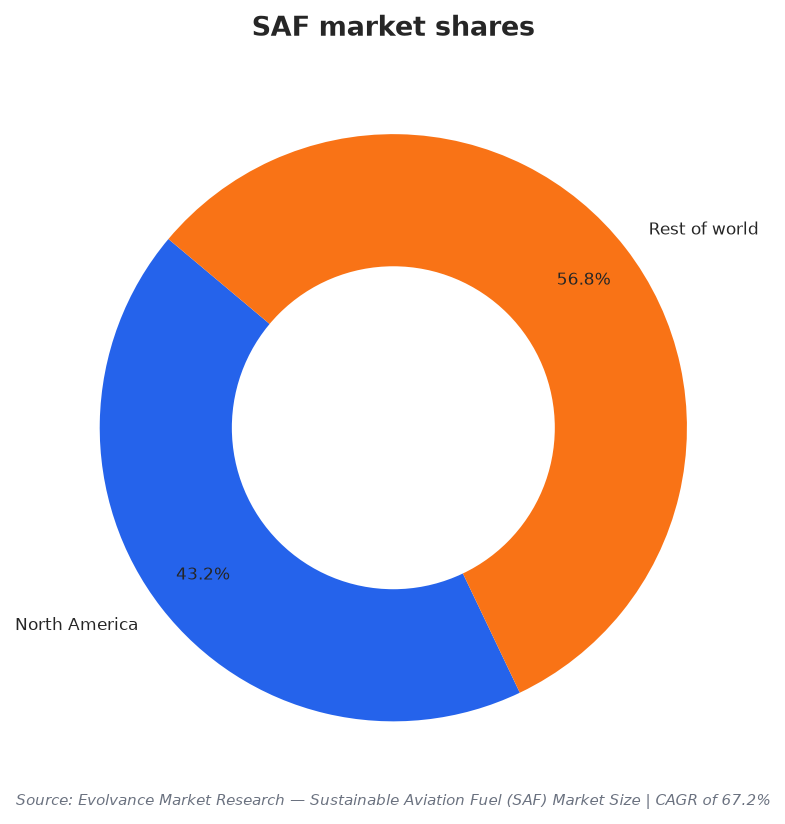
Alongside bio-based pathways, the investment narrative is increasingly influenced by synthetic fuels. One report anticipates the Power-to-Liquid (PtL / e-SAF) segment will grow at the fastest CAGR of 33.3% over the forecast period, driven by long-term scalability and a sustainability profile that is not constrained by agricultural land or waste feedstock availability, because it uses renewable electricity and captured carbon dioxide. In the UAE context, a renewable aviation fuel report states that the Middle East positions itself as a PtL hub and that Masdar’s 200,000 ton Abu Dhabi facility will leverage low-cost solar. The same source adds that the UAE’s Emirates has signed a 15-year offtake agreement, a deal structure that aligns with a broader shift from spot purchases to multi-year offtake agreements as SAF procurement becomes more compliance-driven.
The aviation decarbonisation investment case strengthens when compliance and measurable outcomes converge. International aviation regulation is increasingly supportive of SAF adoption through ICAO’s Carbon Offsetting and Reduction Scheme for International Aviation (CORSIA), while the EU has introduced SAF blending mandates under ReFuelEU Aviation. That matters to Middle East hubs because the region depends heavily on international transit traffic connecting Europe, Asia, and Africa, and airlines operating into regulated markets must demonstrate emissions reductions and SAF usage compliance. Evidence of measurable impact is also cited in EU operations: EASA reported that SAF delivered at EU airports in 2024 achieved approximately 91% lower lifecycle emissions than fossil jet fuel, saving 714,000 tonnes of CO₂e. For Abu Dhabi-focused investors, the takeaway is practical: projects must balance feedstock realism, refinery-fit execution, and contracted offtake to compete in increasingly audited, standards-driven markets.
What is shaping the Abu Dhabi sustainable aviation fuel market right now?
Which feedstocks are commonly discussed for SAF in the region?
Why does HEFA-SPK matter for scaling SAF?
What Abu Dhabi project signal is cited for PtL / e-SAF?
What proof point is cited for SAF emissions performance in regulated markets?