
In Abu Dhabi, robotics and industrial automation discussions increasingly sit inside a broader UAE push toward advanced manufacturing, smart logistics, and digital transformation. A 2026 UAE market-trends overview describes national momentum around artificial intelligence, digital innovation, and smart manufacturing, supported by government initiatives and infrastructure. In parallel, a UAE smart manufacturing report values the country’s AI-powered smart manufacturing robotics automation analytics market at approximately USD 1.8 billion, and it specifically names Dubai and Abu Dhabi as leading cities due to infrastructure and government support. Together, these signals suggest that Abu Dhabi’s adoption narrative is not isolated; it is part of a coordinated national shift that is shaping procurement decisions in factories, warehouses, and service environments.
On the industrial-robot side, the most direct hard indicators come from a UAE industrial robot market report that tracks consumption and exports over time. It states that in 2025 the United Arab Emirates industrial robot market decreased by X% to $X, marking the second consecutive year of decline after three years of growth, while still indicating resilient expansion over the full period reviewed. Consumption peaked at $X in 2022 and then failed to regain momentum from 2023 to 2025. In exports, the same source reports that UAE industrial robot exports soared to X units in 2025, up by X% year over year, and that export value also soared to $X in 2025, although export values peaked at $X in 2019 and stayed lower from 2020 to 2025. These patterns are UAE-level, but they matter for Abu Dhabi buyers because they hint at supply, pricing, and availability dynamics.
Manufacturing and Warehousing: What’s Driving Deployments
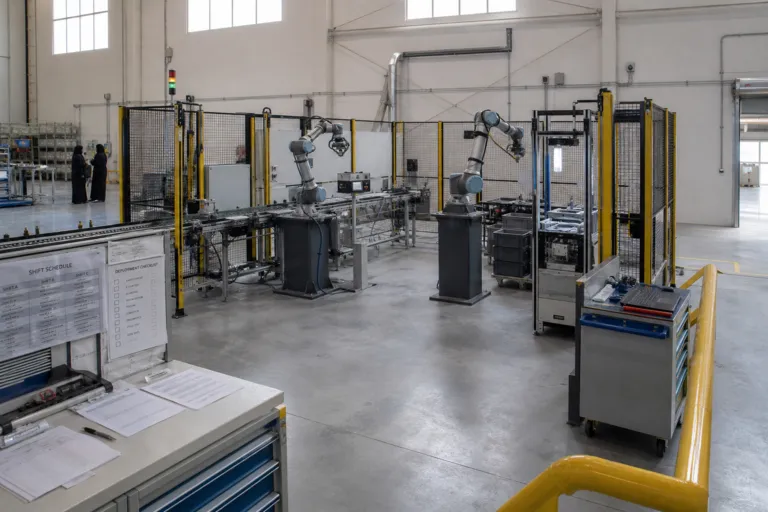
Manufacturing adoption in Abu Dhabi is often framed as part of the UAE’s wider “advanced manufacturing” direction, which a 2026 trends piece links to government initiatives boosting local production across aerospace, pharmaceuticals, electronics, precision engineering, and food processing. On costs and planning, the UAE smart manufacturing source adds a concrete barrier: high initial investment, with the average cost of implementing AI-driven robotics solutions estimated at AED 2 million per facility in the future, which can deter SMEs. At the same time, a UAE supplier guide points to financial support via a new R&D tax credit effective January 1, 2026, offering non-refundable tax credits of up to 50% on qualifying R&D expenditure. For warehouse automation, a global robotics market report notes that free-trade zones in the United Arab Emirates are trialing warehouse AMRs to service regional e-commerce flows and reduce reliance on seasonal migrant labor, giving Abu Dhabi logistics operators a practical reference point when evaluating mobile robotics.
Service-sector adoption is also rising in the UAE context, especially where AI and automation reshape customer experiences and operational workflows. The 2026 UAE market-trends source explicitly lists AI transformation across government services, healthcare, finance, retail, and manufacturing, and it highlights Abu Dhabi’s role as it strengthens its position as a global financial center alongside Dubai. While these are broad categories rather than deployment counts, they help explain why service robots and automation tools can be considered alongside industrial systems. As a regional comparison, a Saudi Arabia robotics market overview segments robotics by application, naming logistics and warehousing, healthcare, and hospitality and services among key use cases, illustrating that GCC adoption is not limited to factory floors. This context supports a more complete view of the Abu Dhabi robotics automation market as spanning industrial and service workflows, not just production lines.
Finally, a few market-wide signals can shape expectation-setting without being misread as Abu Dhabi-only results. A global robotics report states the Middle East registers a 21.31% CAGR to 2031, framing a high-growth regional backdrop as capital is directed into industrial digitalization, logistics, and healthcare robotics. Within the UAE, the supplier guide projects that by the end of 2026 the UAE industrial automation market is projected to reach a valuation exceeding AED 39.7 billion. The same guide ties adoption to smart city initiatives across Dubai and Abu Dhabi and to national programs, while the UAE industrial robot trade data highlights that exports in 2025 went mainly to the Netherlands, India, and the United States (by units), and that the average export price stood at $X thousand per unit in 2025, down by X% year over year. For Abu Dhabi decision-makers, these signals reinforce a simple takeaway: local adoption planning benefits from watching UAE incentives, logistics trials, and the industrial-robot trade cycle together.
What is shaping the Abu Dhabi robotics automation market right now?
What is the current size indicator for smart manufacturing robotics in the UAE?
What cost challenge can slow facility-level robotics adoption?
Are there measurable signals in UAE industrial robot trade activity?
What do sources say about warehouse robotics in the UAE?