
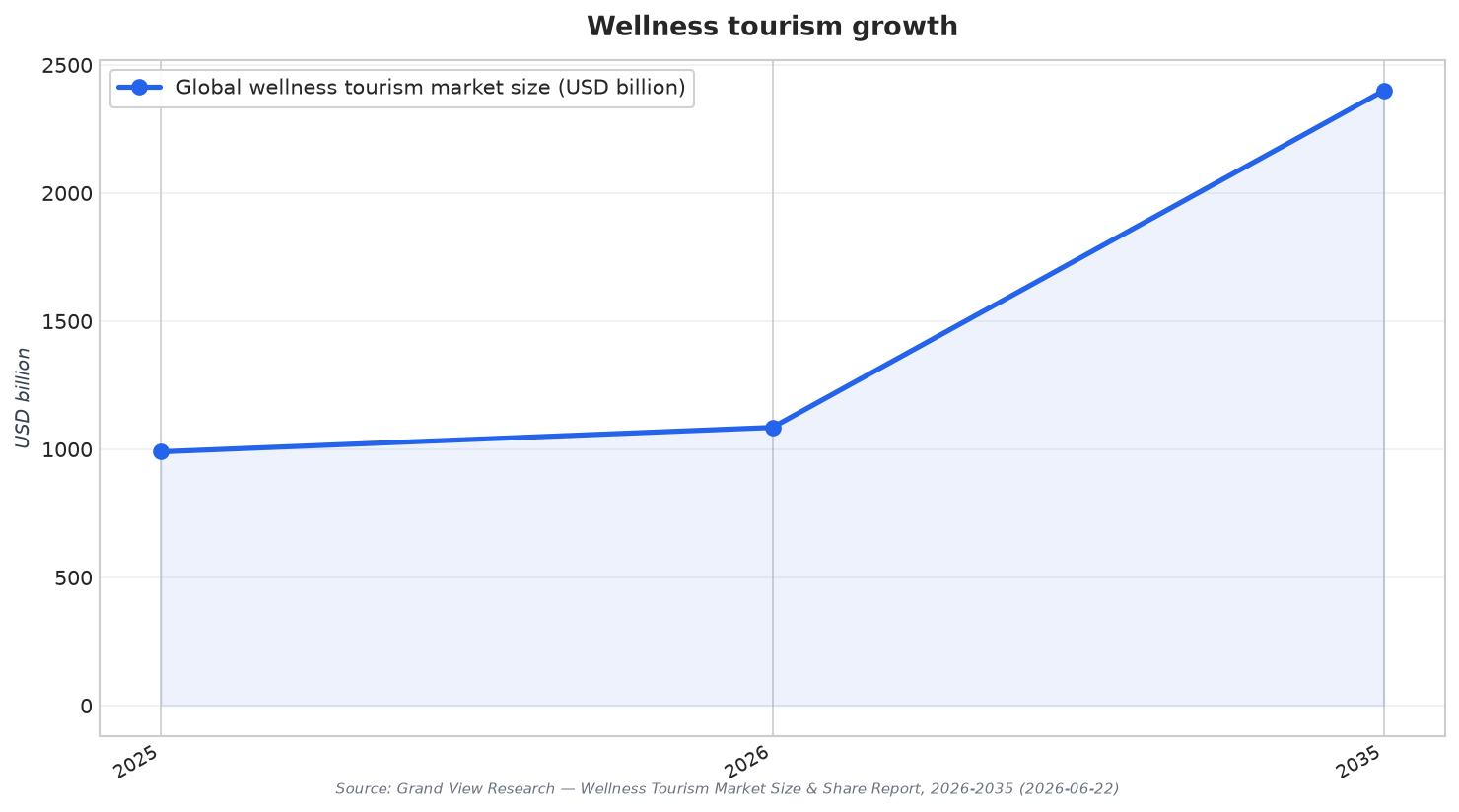
Wellness travel is getting bigger globally, and the shift toward preventive and longevity-led experiences is becoming more explicit. Grand View Research values the global wellness tourism market at USD 990.4 billion in 2025 and projects growth from USD 1,085.6 billion in 2026 to USD 2,400.0 billion by 2035, at a 9.3% CAGR. Precedence Research also sizes the global market at USD 1,032.38 billion in 2025, forecasting around USD 2,185.40 billion by 2035 at a 7.79% CAGR. Both views point to the same directional change: programs are moving beyond classic spa breaks toward immersive, personalized packages that blend diagnostics, preventive healthcare, and longevity themes.
For the Abu Dhabi wellness tourism market, the near-term opening is strengthened by a broader UAE medical-travel backdrop and by traveler behavior. Travel And Tour World reports the UAE as the largest and fastest-growing medical tourism market in its regional landscape, with revenues estimated to rise from USD 196.8 million in 2022 to USD 780.1 million in 2025. The same source says Dubai and Abu Dhabi handle hundreds of thousands of international patients each year and highlights hospitals such as Cleveland Clinic Abu Dhabi. It also describes a 2026 pattern of “second-purpose” journeys, where travelers add medical tasks while transiting or visiting hubs like Abu Dhabi, rather than traveling solely for a procedure.
Clinics and Resorts: Where Medical Meets Luxury in 2026
The most valuable products for 2026 are positioned at the intersection of medicine, hospitality, and personalization. Grand View Research describes new resort concepts that emphasize medical wellness services aimed at physiological conditions such as menopause, hormonal health, longevity, and preventive care, supported by advanced diagnostics, medical testing, and personalized treatment programs. It also notes that wellness tourism is largely positioned as a premium or luxury offering, where high-end resorts, specialized therapies, and medically integrated services command elevated price points, supporting strong margins per traveler but narrowing the target audience to affluent individuals, corporate executives, and international medical-wellness travelers. This aligns with OpenPR’s description of “Medical Travelers” seeking clinical excellence with five-star amenities across premium hospitals, recovery resorts, concierge agencies, and longevity clinics.
Demand signals in the UAE also connect to prevention, lifestyle coaching, and longer-horizon health management. Wifitalents reports that 44.2% of UAE adults (18+) were physically inactive in 2016, while 23.2% reported hypertension and 10.0% reported diabetes in 2016. The same source cites 38.2% as obese or overweight (BMI ≥25) in 2016 and 12.2% reporting mental health conditions in 2016 (age-standardized). On the cost side, it reports USD 1.8 billion in out-of-pocket health spending in 2019 and that 29.5% of UAE health expenditure came from out-of-pocket payments in 2019. For wellness operators, these figures frame why structured preventive programs, activity-focused retreats, and mental wellness offerings can resonate—especially when packaged in premium formats.
Execution in 2026 also requires clear positioning and risk management, because wellness sits in a complex regulatory zone. Grand View Research warns that wellness tourism can fall into regulatory grey areas, with services such as detox programs, thermal therapies, holistic healing, and longevity treatments often lacking uniform clinical guidelines or practitioner licensing frameworks in many countries, which can create inconsistencies in quality and safety. That pushes Abu Dhabi providers to differentiate through transparent clinical governance, medically supervised diagnostics, and tightly designed hospitality-to-clinic pathways. Travel And Tour World notes that, in Abu Dhabi, medical tourism hotel packages can include visa assistance, insurance, airport meet-and-assist, transfers, shuttles between hotel and hospital, and optional city tours—an operational model that helps convert clinical demand into a high-value, end-to-end guest journey.
What is driving the 2026 opportunity for wellness and longevity travel in Abu Dhabi?
How big is the global wellness tourism market heading into 2026?
Which health needs in the UAE can wellness programs target most directly?
What does “second-purpose” medical travel mean for Abu Dhabi providers?
How should operators think about positioning the Abu Dhabi wellness tourism market for high-value travelers?