
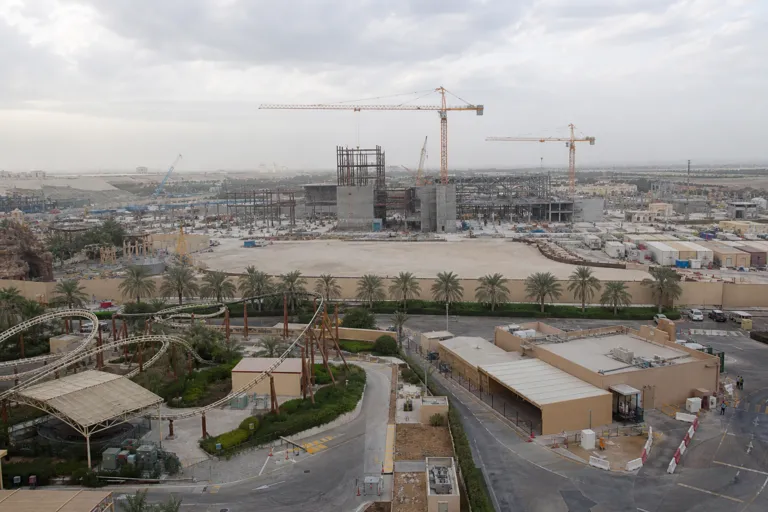
Abu Dhabi is using leisure and entertainment as a practical tool for economic diversification. Yas Island sits at the center of that playbook, and new announcements have amplified the pace. Disney has confirmed its next theme park will be built in Abu Dhabi, with a strategic partnership model where Miral funds, builds, and operates the resort while Disney licenses IP and provides oversight, receiving royalties. Miral has already built a portfolio of indoor parks on Yas Island that includes Warner Bros. World, SeaWorld, and Ferrari World. The effect is not only on tourism narratives but also on local market signals: on Yas Island, annual rent for a one-bedroom apartment rose from AED55,000 in 2023 to AED92,000 this year, a 67% jump, according to government figures.
Policy targets are explicit, and they create a clear scorecard for the leisure investment wave through 2030. In 2025, Abu Dhabi hosted 26.6 million visitors and 5.9 million hotel guests, according to its tourism agency. The emirate hopes to attract 39.3 million visitors per year by 2030 and increase tourism’s contribution to GDP to AED90 billion ($24.5 billion). The Abu Dhabi Tourism Strategy 2030, launched in 2024, lays out billions of dollars of spending on infrastructure and other initiatives, including marketing. Even amid regional uncertainty, officials and analysts highlighted how perception of safety and sustained marketing can influence recovery timelines and travel decisions.
Disneyland, Sphere, and a Yas Island Cluster Strategy
Two projects crystallize how the Abu Dhabi theme park economy is being designed as an interconnected destination rather than a single-asset bet. First, Disneyland Abu Dhabi is slated to open in the early 2030s on Yas Island. Second, the emirate has announced a $1.7-billion investment in the Sphere entertainment venue, also set for Yas Island. Sphere Entertainment’s CEO James L. Dolan said Sphere Abu Dhabi will establish Yas Island as a destination in the region for immersive experiences, and that the company looks forward to working with DCT Abu Dhabi to bring it to life. Together, these developments reinforce the logic of clustering: visitors can be pulled through multiple attractions, while the destination can layer family entertainment, immersive venues, and branded experiences.
Regional competition is rising at the same time, which is why Abu Dhabi’s approach leans on speed, visibility, and partnerships. Saudi Arabia is pressing on with Qiddiya, described as an entire theme park city. Bahrain has announced ambitions for a Disneyland competitor from Six Flags. Qatar is working on a string of large waterparks along its coastline. Against that backdrop, Abu Dhabi is also investing in cultural anchors, including the Saadiyat Island Cultural District, home to an international outpost of the Louvre, with a branch of the Guggenheim Museum described as nearing completion. The result is a tourism proposition that mixes culture with mass entertainment, rather than forcing travelers to choose one or the other.
Multiple data points underline why operators and policymakers see a long runway. IAAPA’s chief executive Jakob Wahl said tourism recreation spending in the region is projected to grow by 19% by 2030, reaching $35.6 billion. Globally, Grand View Research valued the theme park market at $67.9 billion in 2025 and projected growth from $71.5 billion in 2026 to $110.6 billion by 2033, at a 6.4% CAGR. In the UAE context, aviation connectivity is framed as an enabler: Abu Dhabi and Dubai airports handled 159 million passengers, up 8% from 147.8 million previously. Abu Dhabi’s bet is that new flagship assets on Yas Island can convert that connectivity into longer stays, higher spending, and repeat visits.
What is driving Abu Dhabi’s theme park economy toward 2030?
How is Disneyland Abu Dhabi being funded and operated?
How much investment is planned for Sphere Abu Dhabi, and where will it be located?
What recent tourism figures has Abu Dhabi reported?
What is one local economic signal tied to Yas Island’s development push?