
In 2026, Abu Dhabi’s sovereign investment system is increasingly treated as a market force, not a background pool of capital. Multiple sources estimate that ADIA, Mubadala, and ADQ together manage about $1.7 trillion, with breakdowns that vary by estimate: ADIA is cited at roughly $993 billion in early 2026, or about $870 billion as of end-2025 in another snapshot; Mubadala is repeatedly cited around $302 billion; and ADQ is cited at $157 billion in one estimate, $200B+ in another, and roughly $263 billion in a Bloomberg-reported recap. This creates an environment where scale matters, but so does the way each fund deploys, partners, and selects sectors.
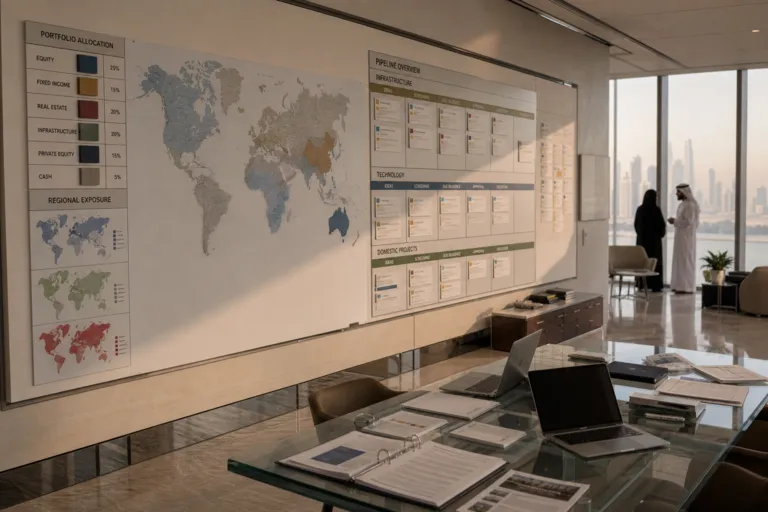
ADIA’s deployment profile remains allocation-driven and globally diversified. It was founded in 1976, and it is described as passive and broadly diversified, with no board seats and limited public disclosure of specific holdings. Its disclosed allocation ranges (from its Annual Review, as cited) include developed market equities at 32–42% and fixed income at 10–20%, plus ranges for private equity (8–15%), real estate (5–10%), and infrastructure (3–7%), with additional alternatives at 2–8%. In the US, ADIA is described as having significant exposure across real estate, infrastructure, and private equity, with a US real estate portfolio estimated at $40–60 billion. It has also been increasing US residential real estate allocation since 2022, tied to a structural housing undersupply narrative in that market context.
2026 Deployment Trends: Divergent Mandates, Shared Market Impact
Mubadala’s deployment trend is positioned as the opposite of passive. It is repeatedly framed as active and strategic, using investments to build industrial capability and import technology and expertise into Abu Dhabi’s diversification agenda. A key data point on pace comes from 2024: Mubadala deployed $29.2 billion across 52 transactions, a 67% year-on-year increase, and was described as the world’s most active sovereign investor that year. In US-linked technology exposure, it is cited as holding stakes in AMD and GlobalFoundries, and as having stakes in major US venture capital funds. In parallel, Abu Dhabi’s broader network includes sector vehicles and partnerships mentioned in Bloomberg reporting, including MGX, described as an AI investor targeting $100 billion of assets, and references to multi-billion-dollar private credit partnerships with Apollo Global Management in a separate recap.
ADQ’s 2026 positioning is framed as domestic economic engine plus regional infrastructure and food security orientation. It is repeatedly described as the fastest-growing of the three, with one report stating it more than doubled in size in four years. Another source highlights its regional portfolio footprint, stating ADQ’s Egyptian portfolio exceeds $35 billion and is anchored by the Ras El-Hekma development. In a market context where sovereign capital is filling gaps, a recap also references a white paper forecasting a $100 trillion global infrastructure gap by 2040, which ADQ executives cited as a roadmap for deployment across clean energy, transport, and digital networks. That framing matters because it links capital deployment decisions to where governance, regulatory clearances, and operational control can realistically be executed.
Across 2026, the deployment story is also about coordination and external pull. Bloomberg reporting describes Abu Dhabi’s three funds having done “hundreds of deals in recent years,” and notes that Abu Dhabi has become a “must-visit stop in every major fundraising cycle,” with particular emphasis on private equity, infrastructure, and especially private credit as Western banks step back. At the same time, the UAE’s capital flows into the US are framed through a separate, specific commitment: a $1.4 trillion, 10-year US investment pledge, described as spanning AI, semiconductors, clean energy, and infrastructure. For allocators tracking Abu Dhabi sovereign wealth funds, the practical 2026 takeaway is that the emirate’s influence is being expressed through multiple vehicles, distinct mandates, and sustained deployment across sectors that sit close to critical infrastructure and technology supply chains.
How large is Abu Dhabi’s sovereign fund system in 2026?
What is ADIA’s allocation approach in 2026?
How active was Mubadala’s deal deployment recently?
Why is ADQ described as the fastest-growing of the three?
How are Abu Dhabi sovereign wealth funds shaping US market flows in 2026?