
In Abu Dhabi, many B2B teams diagnose losses using what sales reps type into CRM, a quick internal retro, and a slide deck that arrives after the quarter is over. That approach can be misleading. A 2026 “Buyer Truths” survey of 172 B2B buyers reported that 65% of buyers do not tell you the real reason you lost, and only 35% give comprehensive, accurate feedback. If your pipeline decisions depend on those stated reasons, the picture can be incomplete. This is why a B2B win-loss analysis UAE program needs to be built like an intelligence system, not a one-time report.
One common Abu Dhabi failure mode is thinking you are competing late, when you were never really in the race. The same 2026 “Buyer Truths” survey found that 55% of buyers evaluate only two new vendors. That means many deals are effectively decided at the shortlist stage, before your team even gets a fair chance to demo, negotiate, or position implementation plans. This is also where “pipeline bias” shows up. If you only interview buyers who entered your CRM, you miss competitor customers who chose someone else before they ever spoke to your sales team, and your strategy is shaped by the deals you saw rather than the market you want to win.
How to Run Win-Loss Research That Actually Changes Outcomes
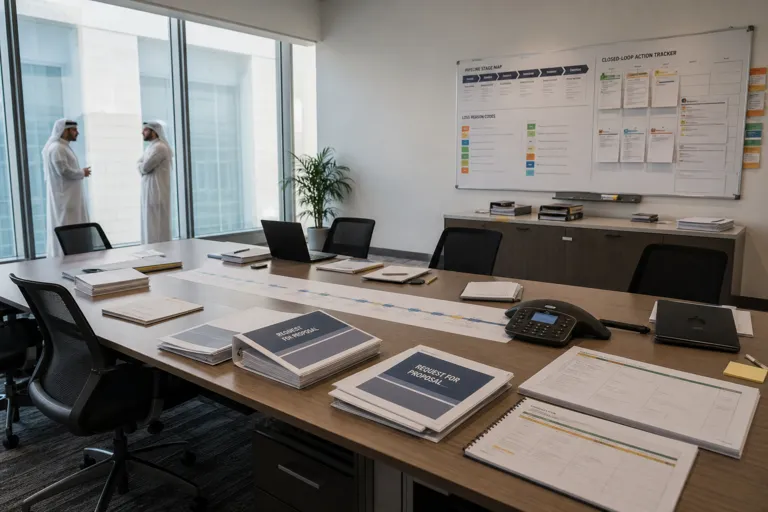
A practical program starts with operational design, then moves into interviews, analysis, and action tracking. One template framework describes five connected components: a program setup checklist, a structured interview guide, a response coding and analysis framework, a reporting format tied to team-specific actions, and an action tracking system to close the loop between insight and change. That same framework is based on patterns observed across 10,247 post-decision buyer conversations. It also sets concrete thresholds: a minimum viable sample of 20–30 interviews in a specific segment or competitor pairing to see directional patterns, 50+ conversations for primary loss themes to stabilize, and 100+ to segment meaningfully by factors like deal size and buyer persona.
Timing and data plumbing matter as much as questions. The template recommends interviewing within 2–4 weeks of the decision because buyer memory degrades quickly; at 6+ weeks, buyers can reconstruct narratives rather than report them, introducing distortions. On sampling, it recommends including both wins and losses and aiming for a 40/60 win/loss split, prioritizing competitive losses over “no decision” outcomes for the first 30 interviews. On CRM setup, it calls for basics that enable analysis later, including a contact email for the primary decision-maker on closed deals, a competitor field on competitive deals, stage timestamps for cycle-length analysis, and deal value recorded at time of close.
Finally, Abu Dhabi leaders should insist on research that lands in sales execution. One practical guide argues the output should not be a quarterly PDF, but always-current artifacts such as a loss-reason dashboard, a live list of top objections, a competitive signal log, and a standing item in weekly pipeline reviews where recent losses get discussed. It also notes that only 39% of companies run ongoing, cross-functional programs, citing Clozd’s 2025 State of Win-Loss report. And when teams do get closer to reality, the “reason” can change: a 2026 analysis by Basis Global of 7.2 million recorded B2B buyer conversations found that 58% of late-stage deals fail because of implementation risk, not price. That kind of insight can directly reshape messaging, discovery, enablement, and product decisions.
How do Abu Dhabi firms end up with the wrong loss reasons?
How many interviews does a win-loss program need to see patterns?
When should teams interview buyers after a deal closes?
What is the biggest shortlist risk in B2B buying decisions?
What does B2B win-loss analysis in the UAE focus on beyond price?