
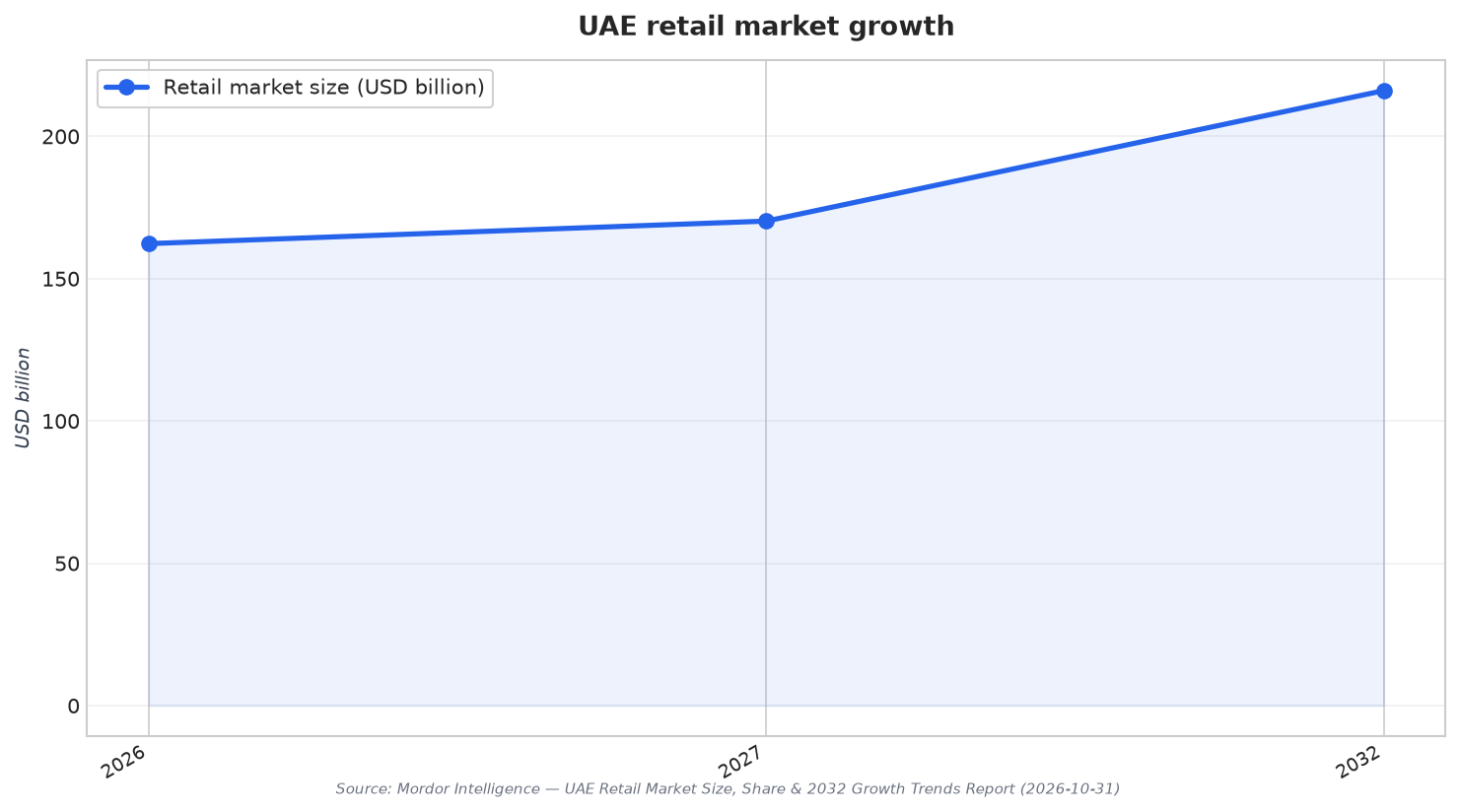
Abu Dhabi’s mall ecosystem sits inside a UAE retail economy that Mordor Intelligence values at USD 162.31 billion in 2026. The same report estimates growth from USD 170.23 billion in 2027 to USD 216.07 billion by 2032, at a 4.88% CAGR for 2027–2032. In that backdrop, the emirate is also notable for scale. A UAE mall statistics compilation using Smartscrapers counts 766 shopping malls nationwide in 2026, with Abu Dhabi leading at 268 malls. For the Abu Dhabi shopping mall market, this density matters because footfall is not only about tourism peaks. It is also about serving daily resident demand across everything from essentials to dining and social time.
Footfall drivers in the UAE are increasingly multi-layered. The same mall statistics source reports that 6 in 10 UAE residents visit a mall at least once a week, and that most spend between AED 100 and AED 500 per trip. Those habits support a model where malls are positioned as places to eat, socialize, watch films, and escape the heat, not just to shop. Nationally, Mordor Intelligence reports that in-store retail accounted for 67.93% of UAE retail market share in 2026, a reminder that physical retail still carries the bulk of activity even as online retail is projected to grow at a 7.84% CAGR through 2032. The implication for Abu Dhabi is to use experiences and convenience to defend visit frequency as digital purchasing rises.
Tenant Mix Strategy: Scale, Luxury Curation, and Lease Flexibility
Tenant mix decisions are being shaped by both flagship scale and portfolio-level coordination. Yas Mall is described as the largest mall in Abu Dhabi at 2.5 million sq ft, with around 370 retail stores and a 20 screen VOX cinema, anchoring an experience-led draw. At the portfolio level, Mordor Intelligence’s UAE luxury goods report notes that in February 2026 Aldar Properties and Mubadala Investment Company completed an AED 10 billion joint venture to create a consolidated retail platform that includes Yas Mall and The Galleria Luxury Collection. The report frames this platform as a way to curate premium tenant mixes and create clearer pathways for flagship placement, pop-ups, and cross-mall activations, which can tighten brand adjacency planning and promotional calendars.
Leasing conditions also influence mix strategy. JLL’s Q2 2026 UAE Retail Market Dynamics notes that Abu Dhabi displayed resilience with 4.4% annual growth, driven by both new contracts and renewals, and highlights lower tourism dependency alongside “strong fundamentals.” JLL also reports that prospective tenants are increasingly seeking lease flexibility and operational incentives to manage cost pressures, with landlords selectively providing flexible deal structures and performance-based terms. That shift pairs with a more experience-led direction described by MarkWide Research, which says experiential retail formats are compressing traditional lease structures as foot traffic migrates toward entertainment-anchored properties, forcing landlords to renegotiate tenant mixes and dwell-time metrics.
Experiential retail investment is also tied to luxury and destination positioning. MarkWide Research states that tourist visitation and luxury retail demand drive mega-center expansions in Dubai and Abu Dhabi, while emphasizing the move toward entertainment-anchored properties. In parallel, the luxury goods report highlights developments such as retail spaces near the Louvre Abu Dhabi and the newly opened Baccarat Hotel as part of enhancing Abu Dhabi’s luxury offering. It also notes AED 25 billion in real estate transactions recorded in Q1 2025, framing wider investment momentum around waterfront projects and cultural attractions. For mall owners and tenants, the playbook is to invest in reasons to stay longer—cinema, dining, pop-ups, and coordinated activations—so that weekly visitation patterns translate into higher conversion across a curated mix.
How many shopping malls are there in Abu Dhabi in 2026?
What does JLL say about Abu Dhabi retail leasing performance in Q2 2026?
What investment signals are shaping the Abu Dhabi shopping mall market right now?
How often do UAE residents visit malls, and what do they typically spend per trip?
Why are malls focusing more on experiential and entertainment-led formats?