
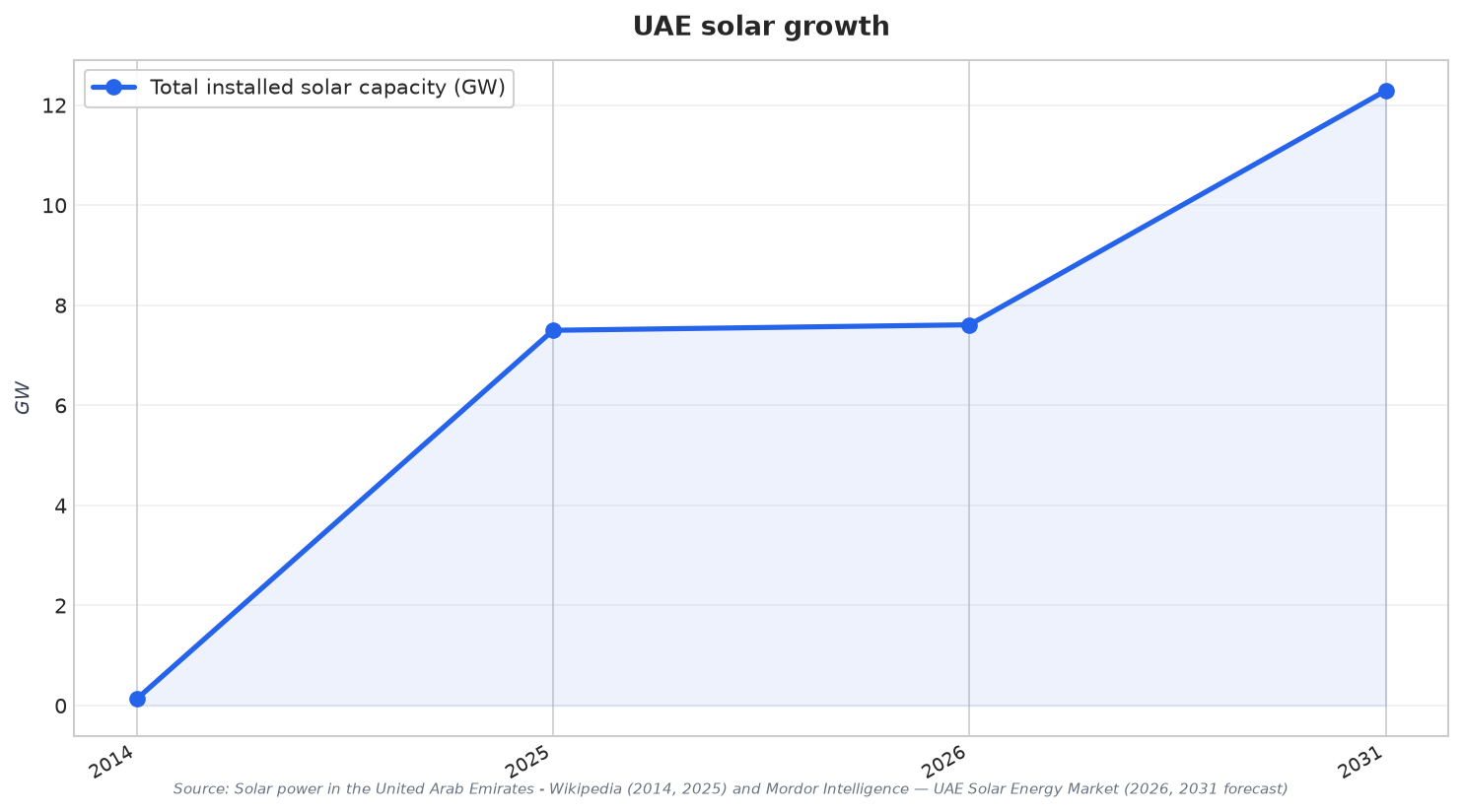
Utility-scale solar is now a defining feature of Abu Dhabi’s power strategy, with project size, ownership structures, and procurement commitments shaping investor confidence. Nationally, total installed solar power capacity in the UAE was over 7.5 GW in 2025, up from 133 MW in 2014. Solar energy provided 4.5% of national electricity generation in 2022 and 8.3% in 2023, compared with 0.3% in 2014. One market report also notes that Abu Dhabi and Dubai account for over 90% of total installed solar capacity by megawatt, reinforcing how the country’s biggest emirates dominate delivery at scale.
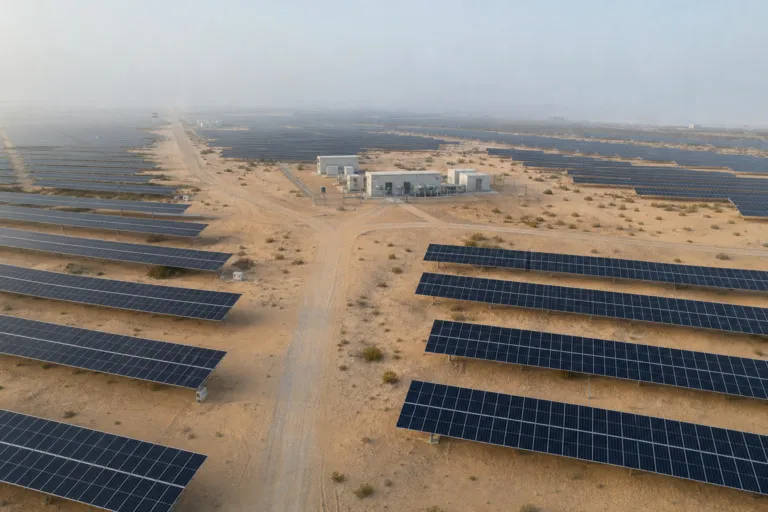
Al Dhafra is the flagship reference point for the Abu Dhabi solar energy market discussion because it combines size, tariff signaling, and a global developer mix. Wikipedia describes the Al Dhafra Solar project as a 2 GW PV plant in the Al Dhafra region, about 35 km south of Abu Dhabi City, built on 20 square kilometres using bifacial crystalline technology, and officially opened in November 2023. It reports a tariff of AED 4.97 fils/kWh (US 1.35 cents/kWh). A separate market report states the project size as 2,100 MW and says it reached commercial operation, and it provides a different ownership split: Masdar (42%), EDF Renewables (18%), and JinkoPower (40%). That same report also states UAE solar LCOE reached record lows below USD 0.015/kWh at Al Dhafra.
Masdar’s Platform: From City-Scale PV to Utility-Scale Execution
Masdar’s Abu Dhabi footprint spans early demonstration assets and today’s utility-scale buildout. In Masdar City, power is generated by a 10 MW solar PV plant located on site and 1 MW of rooftop solar panels, with Wikipedia noting that ground-mounted panels were easier to clean than distributing panels across rooftops. Beyond the city, Masdar is repeatedly positioned in market research as the UAE’s flagship renewable energy developer with a 20+ GW global portfolio across 40+ countries, and as a co-developer of Al Dhafra. For energy-intensive users, Wikipedia also notes an Abu Dhabi data center labeled AUH 6 where Masdar delivered infrastructure with 7 MW generated by an on-site solar PV plant.
Looking toward 2030, the pipeline is increasingly defined by EWEC procurement and by projects that combine PV with battery energy storage. Mordor Intelligence states Abu Dhabi led installed capacity in 2025 on the back of EWEC’s 2 GW Al Dhafra plant and “three 1.5 GW projects in the pipeline,” while also noting an emirate target of cumulative solar above 7.65 GW by 2031 plus 400 MW of battery storage. A separate Mordor PV report adds named near-term volume: the 1.5 GW Al Ajban project and a 5.2 GW solar-plus-19 GWh storage megaproject slated for 2027. It also states Abu Dhabi’s Department of Energy mandates EWEC to source 1.4 GW of renewables annually from 2027, anchoring predictable offtake.
Abu Dhabi’s utility-scale momentum sits inside a wider national framework that also frames the 2030 discussion. The same PV market source states the UAE Energy Strategy 2050 obliges 44% clean energy and 14.2 GW of renewables by 2030, while also describing procurement structures that reduce risk for developers. Nexdigm notes Al Dhafra’s 2,000 MW project was planned and procured by EWEC under a 30-year PPA, showing how long-tenor contracting supports financing. For Abu Dhabi specifically, the PV market source highlights a major October 2024 announcement: Masdar, G42, and ADQ planned an AED 22 billion investment for a 5.2 GW PV plant paired with 19 GWh of battery storage in Abu Dhabi, designed to deliver 1 GW of baseload renewable power around the clock and scheduled for commissioning in 2027.
What is Al Dhafra’s reported PV capacity and why does it matter?
What tariff or LCOE figures are cited for Al Dhafra?
What projects define Abu Dhabi’s solar-plus-storage pipeline?
How does EWEC’s procurement approach shape the Abu Dhabi solar energy market outlook?
What is Masdar’s role in Abu Dhabi solar development?