
The Abu Dhabi oilfield services market sits inside a wider regional upcycle that is being driven by national oil companies and shifting service demand. Mordor Intelligence estimates the Middle East oilfield services market at USD 29.34 billion in 2025 and USD 31.08 billion in 2026, with a forecast to USD 40.56 billion by 2031 at a 5.47% CAGR (2026-2031). Within that regional mix, drilling is still the single largest line item, holding a 34.9% share in 2025, while production and intervention services are forecast to grow faster at a 7.5% CAGR through 2031. For Abu Dhabi-focused contractors, this points to a multi-year pivot toward sustaining production from existing wellbores, not only adding new wells.
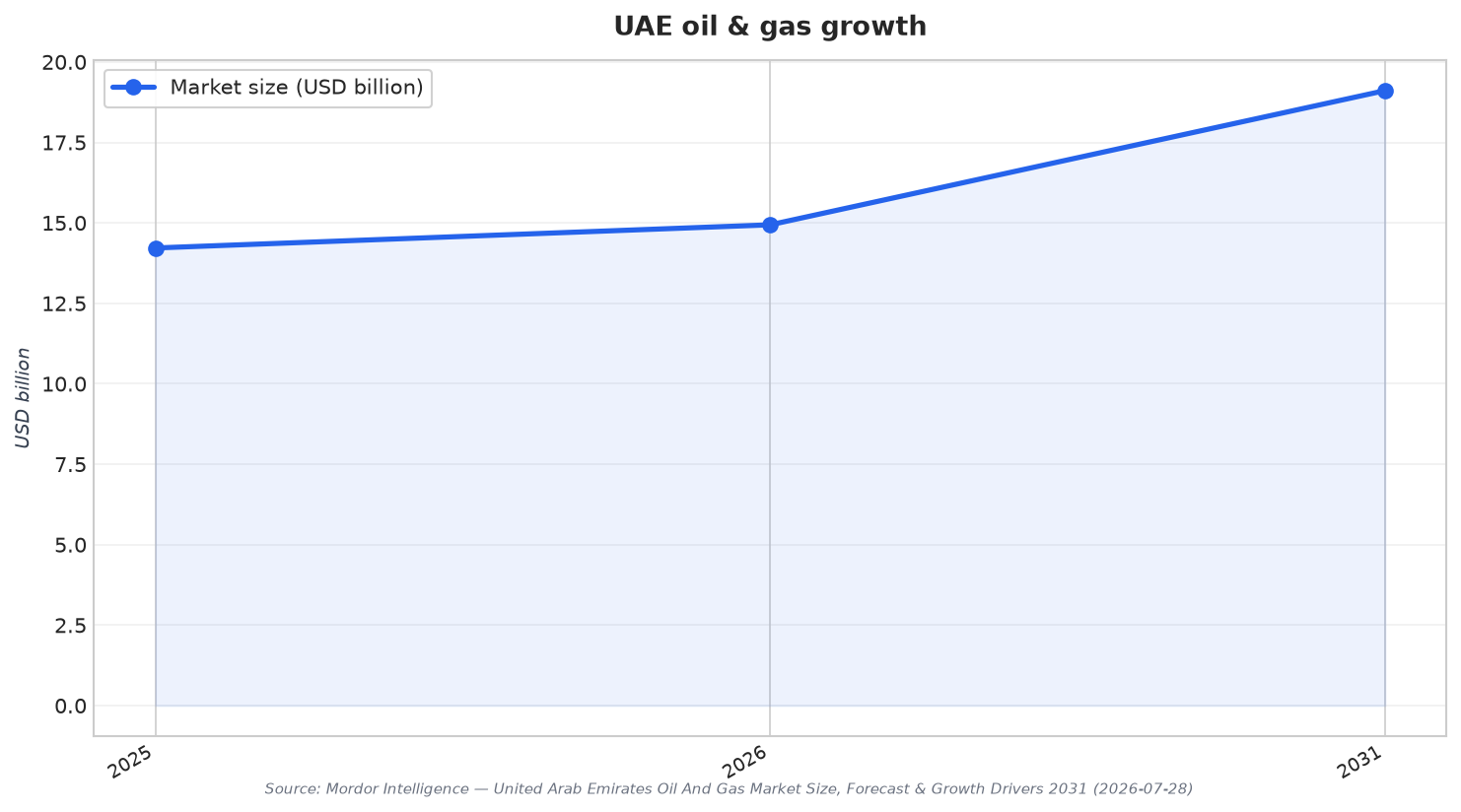
ADNOC’s own growth plans give the clearest signal on 2027 opportunities. Mordor Intelligence links the UAE’s oil and gas market expansion to ADNOC’s USD 150 billion upstream investment plan and states ADNOC is spending USD 150 billion through 2027 to lift nameplate oil capacity to 5 million bpd. The same source highlights that field digitalization spans over 30 reservoirs and has reduced well-planning time by 25%, indicating demand for data services, real-time decision support, and execution partners that can work inside ADNOC’s operating model. Another Mordor Intelligence report adds that Abu Dhabi anchors over 94% of national reserves and funnels most capex; it notes that the onshore Bab and Bu Hasa clusters alone drew USD 6 billion in 2025 project funds.
In-Country Value (ICV) and the Shift to Integrated Contracting
Localization and procurement design are now as decisive as technical capability. In its MENA oilfield services coverage, Mordor Intelligence notes localization thresholds above 70% in the region, pushing global contractors to establish in-region plants and training centers or accept reduced tender scores. For Abu Dhabi, this ICV pressure lands at the same time ADNOC is scaling digital operations: the same MENA report says ADNOC installed AI-enabled sensors on 2,000 wells to trim non-productive time by 15%. Meanwhile, Market Data Forecast states ADNOC has pioneered an integrated services model through contracts with international firms such as Schlumberger, Baker Hughes, and Halliburton, reinforcing the tender logic toward end-to-end delivery rather than narrow, siloed scopes.
Service mix and location also matter for contractor planning toward 2027. Mordor Intelligence reports that onshore operations made up 82.1% of Middle East oilfield services revenue in 2025, but offshore activity is forecast to grow at a 9.4% CAGR to 2031, reflecting accelerating offshore programs in the UAE and Qatar. For the UAE specifically, Mordor Intelligence estimates onshore assets at 68.92% of the oil and gas market size in 2025, while offshore projects advance at a faster 6.28% CAGR to 2031, supported by programs including Hail & Ghasha and Lower Zakum. MarkWide Research also points to capex concentration in Abu Dhabi’s offshore sour gas developments and Al Dhafra unconventional exploration blocks, reinforcing the near-term need for offshore execution readiness alongside unconventional capabilities.
For contractors targeting 2027, the playbook is increasingly clear: be locally anchored, digitally fluent, and ready for integrated scopes with measurable outcomes. MarkWide Research notes buyer concentration among ADNOC’s operating companies and says procurement teams are unbundling equipment supply from technical services, pushing vendors to compete on outcome-based metrics rather than capital equipment margins. It adds that this is visible in artificial lift tenders, where contractors guarantee production uptime percentages rather than pump delivery specifications. Across the wider ecosystem, Abu Dhabi’s market concentration remains high; Mordor Intelligence states ADNOC holds operatorship stakes above 60% in every producing concession while partnering with ExxonMobil, TotalEnergies, and ENI for technology and capital. That structure shapes the partner landscape, teaming behavior, and qualification pathways for oilfield services work.
What is ADNOC’s upstream spending plan that influences 2027 service demand?
How does localization affect oilfield services bids in the region?
Which service lines are growing faster than drilling in the Middle East context?
Why is offshore capability increasingly important for contractors serving Abu Dhabi?
What is changing in the Abu Dhabi oilfield services market for contractor competition?