
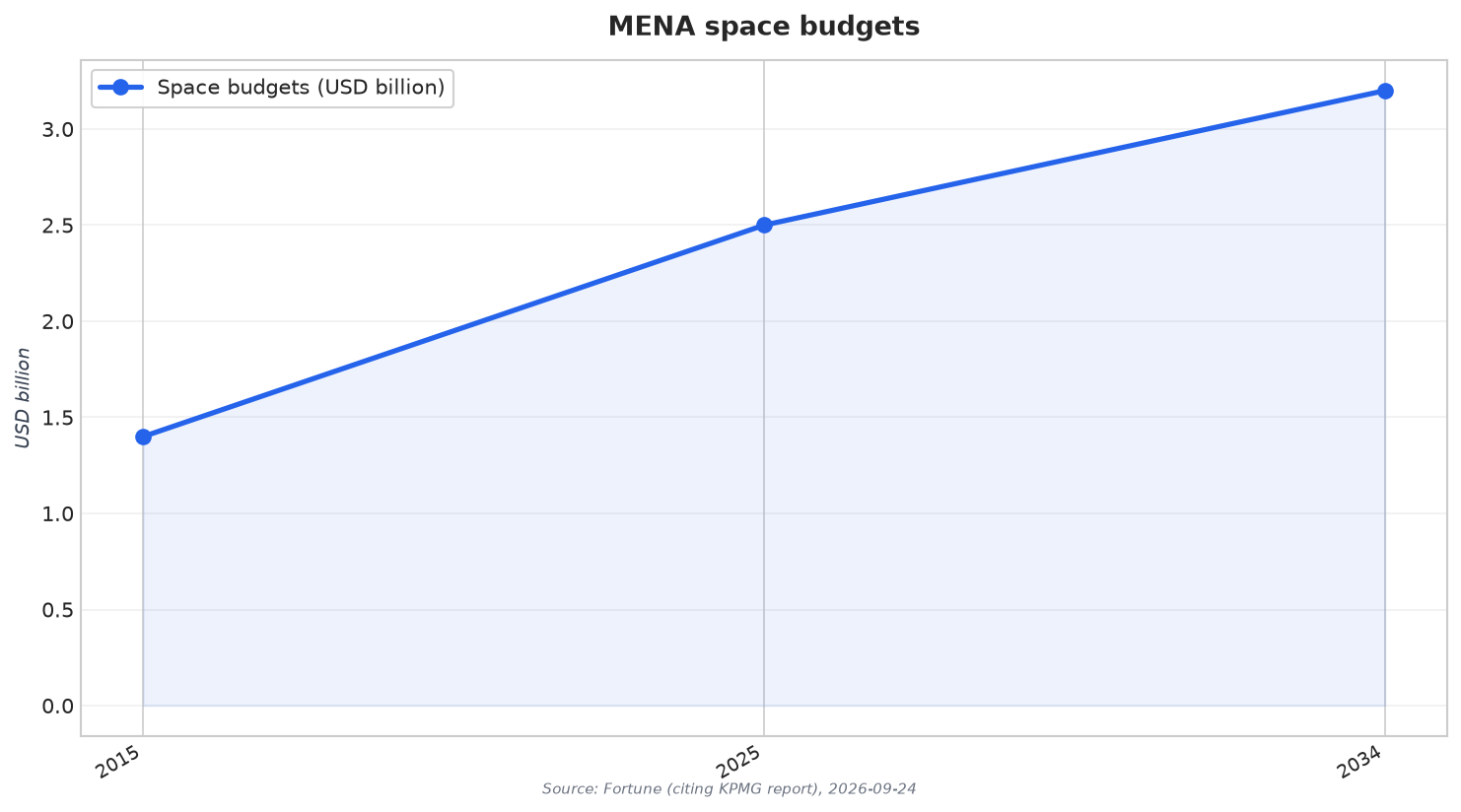
Satellite services are moving to the center of economic planning in Abu Dhabi, shaped by security, resilience, and commercial ambition. A KPMG-cited figure reported by Fortune shows that space budgets across the Middle East and North Africa rose by 69% from $1.4 billion in 2015 to $2.5 billion in 2025, with spending projected to reach $3.2 billion by 2034, a 30% increase from 2025 levels. Within that regional momentum, the UAE is presented as one of the main engines alongside Saudi Arabia, Qatar, and Oman. Fortune also notes how sovereign wealth priorities matter, naming the UAE’s Mubadala among funds treating space as a strategic investment focus.
The policy direction is increasingly explicit about economic outcomes, not only national prestige missions. UAE Vartha reports Cabinet approval of the National Space Strategy 2031 in March, with a mandate to increase sector added value by 60%, double the footprint of homegrown aerospace start-ups, and shift sovereign capability into exportable commercial products. Arabian Business similarly frames the same strategy goals as part of a push to expand exports and broaden the sector beyond satellites and exploration missions into manufacturing, artificial intelligence, data, and investment. In practice, this means more emphasis on downstream services such as Earth-observation analytics and telecommunications, where recurring revenue is linked to the data products generated.
Satellite Services: From Constellations to Direct-to-Device Platforms
Commercial satellite operators are a key bridge between strategy and market activity. UAE Vartha says Space42 brought its Foresight-3, 4, and 5 satellites into full operational service in June, completing a five-satellite synthetic aperture radar and optical constellation that was integrated and tested domestically with Finnish satellite maker ICEYE. The same report describes sub-meter imagery feeding an automated geospatial processing engine that reduces emergency response mapping cycles to minutes. On connectivity, Fortune reports Space42 signed a binding agreement with Viasat to establish Equatys, with the two companies committing up to $1 billion in equity. Fortune adds Equatys will initially comprise fewer than 200 satellites, with plans to expand to 2,800, aiming to lower costs and expand coverage through a shared satellite and ground network for multiple operators.
Government programmes are also being designed to pull commercial value and intellectual property into the country. UAE Vartha reports that in May, the UAE Space Agency opened a 1 billion dirham ($272 million) International Space Cooperation Programme to co-fund research and development contracts linking UAE academic labs with global aerospace defense contractors. It states the funding requires intellectual property development and commercial technology transfer to take place within UAE borders. Arabian Business adds that the number of UAE universities offering specialised space programmes doubled between 2015 and 2025, alongside initiatives such as the National Space Academy, the Arab Youth Space Hackathon, and Space42’s Future Spacers Programme, pointing to workforce and research capacity building tied to the broader value chain.
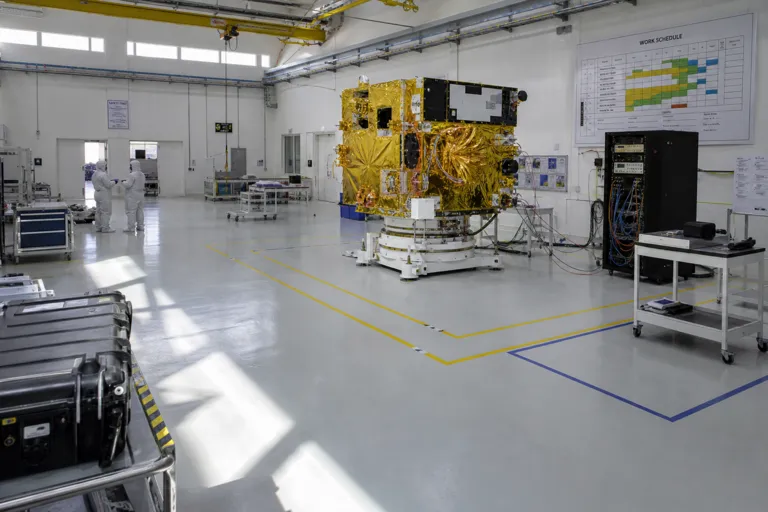
For suppliers, the opportunity set spans manufacturing, testing, and specialized components, not only satellite operations. WIRED Middle East reports that Orbitworks outlined plans for a $1 billion satellite network over five years, alongside a manufacturing facility in Abu Dhabi that can scale production from 10 satellites annually to as many as 50. UAE Vartha reports that Marlan Space partnered with US-based Loft Orbital on a $1 billion project for the Altair-Next Gen constellation, assigning serial manufacturing of the 50-satellite payload to facilities in Abu Dhabi, where the initial 10 units have entered active assembly. PressBee adds corporate consolidation activity, noting International Holding Company’s subsidiary International Tech Group acquired an 80% stake in Marlan Holding, and that Marlan Space and Loft Orbital launched Orbitworks as a $100 million project to develop commercial low Earth orbit satellites. Together, these moves outline how the Abu Dhabi space economy is creating entry points for contractors that can meet production, integration, and data-service requirements.
What is driving the push to commercialize Abu Dhabi’s space sector?
How large is the Equatys satellite plan linked to Space42 and Viasat?
What government programme funds international R&D tied to UAE-based IP development?
What supplier opportunities are emerging in Abu Dhabi’s space manufacturing pipeline?
How is the Abu Dhabi space economy being shaped by regional spending trends?